
Advice and inspiration
How to choose the right rug size

The right rug size is about more than centimetres. It determines whether the furniture reads as one considered group, whether people can move around it comfortably and whether chairs, doors or castors catch on an edge. A rug that is too small often looks like an isolated island in the middle of the room; an unnecessarily large one can restrict walkways or cover flooring that deserves to remain visible.
The most reliable process therefore does not begin by selecting a standard size online. It begins with placing the furniture, measuring the real usable zone and marking the proposed outline directly on the floor. Treat the following rules as practical starting points rather than fixed laws. Every room, seating arrangement and handmade rug has its own proportions.
Measure the furniture zone before the room
A rug does not usually belong at the mathematical centre of an empty floor. Its job is to unite a particular functional zone: a seating group, dining table, bed or hallway route. Complete the basic furniture layout first, then decide where the rug edges need to fall.
- Measure furniture in its actual position. For a seating group, note the outer edges of the sofa and chairs. For a dining table, include the space used by chairs when they are pulled back.
- Check circulation. Include opening doors, extending furniture, radiators, floor sockets and the routes people use every day.
- Mark the whole outline with tape. Use a low-tack paper tape suitable for your floor and make a complete rectangle rather than marking only two corners.
- Leave the outline in place for several hours. View it from the main entrances, in daylight and artificial light, and while the room is being used normally.
- Record a minimum and maximum acceptable size. A hand-knotted rug may have small natural variations, so avoid a millimetre-tight plan.
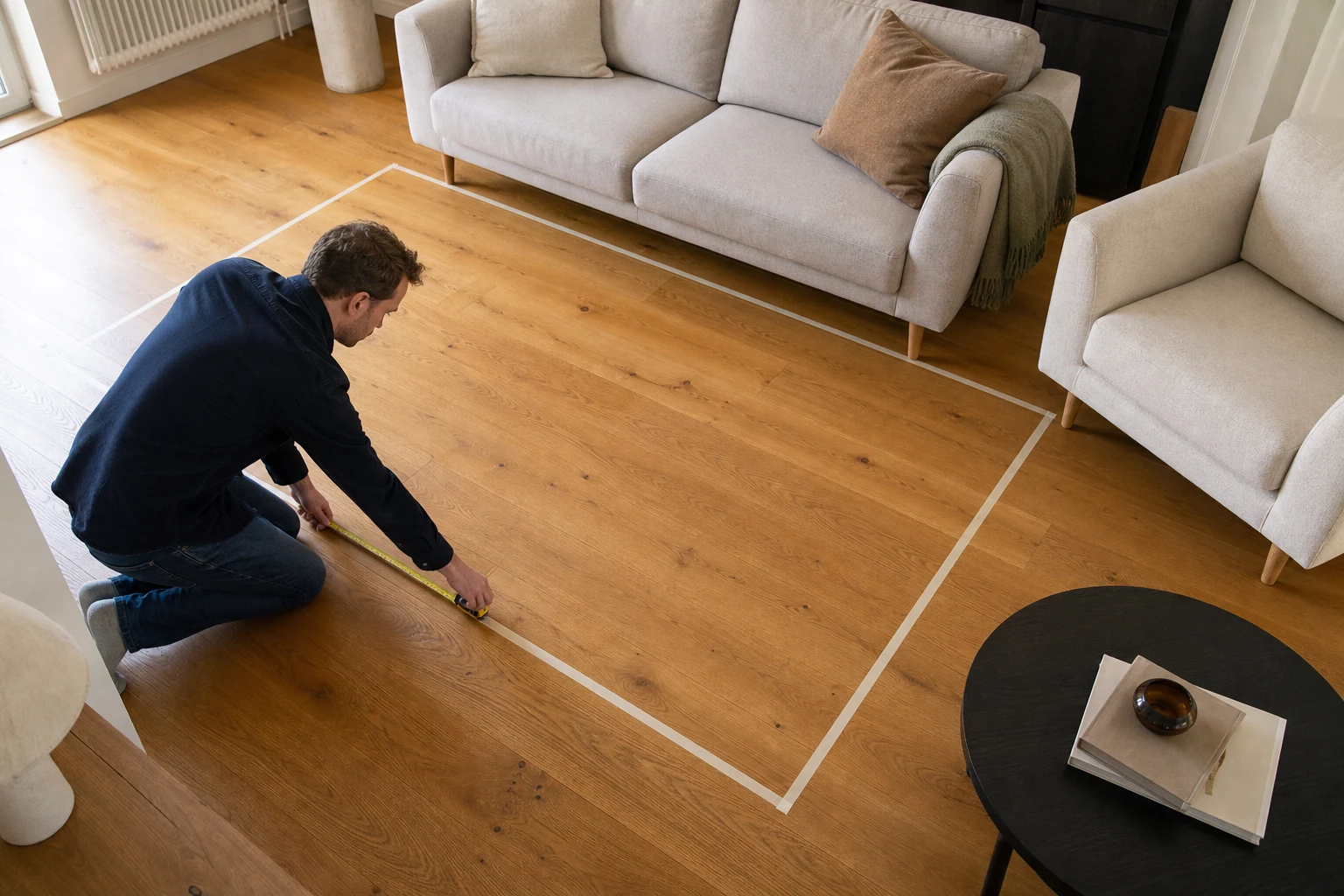
A taped outline quickly reveals whether the rug will connect the furniture, preserve comfortable walkways and feel generous enough for the room.
Living room: the rug should unite the seating group
The most common living-room mistake is a rug approximately the size of the coffee table, surrounded by a wide ring of bare floor. It may be attractive in isolation, but it does not connect the sofa and chairs. The rug should follow the axis of the seating group and generally be at least as wide as the sofa; it often feels calmer when it extends a little beyond each side.
| Layout | How the rug should sit | Where it works |
|---|---|---|
| All furniture on the rug | Every leg of the sofa, chairs and table stands on the rug, with a consistent border around the group | A large or open-plan room where the rug needs to define a complete living zone |
| Front legs on the rug | The front legs of the sofa and armchairs rest securely on the rug; the rear legs may remain on the floor | The most versatile arrangement for an average living room |
| Furniture just beyond the edge | A smaller rug is centred in front of the seating, but its edge sits visually close to the furniture | A compact room or a layout where doors and circulation prevent a larger format |
Common sizes such as 160 × 230, 200 × 300 or 250 × 350 cm can be useful for an initial comparison, but they do not guarantee a successful result. A two-metre sofa with one chair needs a different area from a sectional sofa with two separate armchairs. The relationship between all four rug edges and the furniture matters more than the label attached to the size.
What to check around the coffee table
- The table should stand securely with all its legs at the same level.
- Leave comfortable legroom and circulation between the table and seating.
- A rug edge should not sit exactly where people repeatedly place their feet when standing up.
- With an asymmetrical sofa, follow the whole composition rather than the centre of the room.
Dining room: allow for chairs pulled away from the table
A dining rug is not sized only to the tabletop. Chairs need to remain on the rug while diners pull them back and stand up. If the rear legs cross the edge, the chair can catch, the rug can ruck and the border will receive unnecessary wear.
As an initial check, add approximately 60 to 75 cm beyond the tabletop on every side. Deeper or heavier chairs, a table base that restricts movement or a frequently used dining area may require more. Always confirm the clearance by moving the actual chair through its normal range.
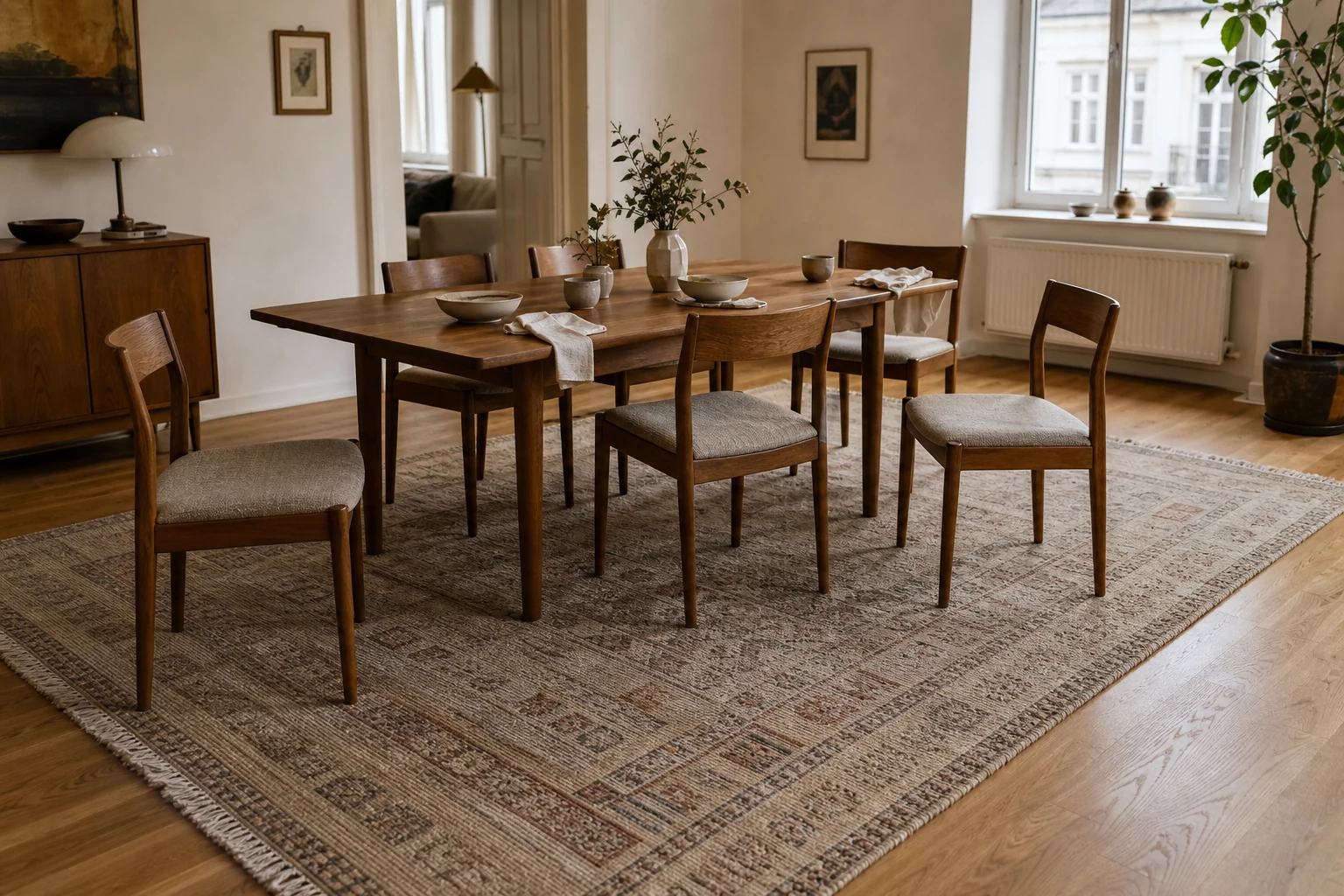
A properly sized dining rug does not stop beneath chairs when they are tucked in. It accommodates their normal backward movement and maintains a calm visual border around the table.
| Table shape | Practical rug shape | What to check |
|---|---|---|
| Rectangular | A rectangle aligned with the long side of the table | A similar allowance behind chairs on every side |
| Round | A round rug, or a sufficiently generous square | Measure the circle created by pulled-back chairs, not only the tabletop |
| Extending | A format based on the position in which the table is used most often | Test the fully extended arrangement and the location of extra chairs as well |
Bedroom: a soft landing where you actually get out of bed
In a bedroom, a rug can sit beneath the bed and bedside tables, begin just in front of the bedside tables or be replaced by two runners. What matters is that a comfortable area remains accessible on both sides of the bed and, where useful, beyond its foot.
With a double bed, the composition often feels balanced when the rug extends roughly 50 to 70 cm at the sides and foot. Adapt that allowance to the walkways, wardrobe doors and any bench at the foot of the bed. In a smaller bedroom, separate runners can be more practical than pushing one large rug far beneath a heavy bed.
- The bed and bedside furniture must remain level; avoid placing only some legs just inside a high rug edge.
- If the bed has drawers, test their full movement.
- With a deep pile, check the clearance beneath doors and wardrobe fronts.
- Position a strong central medallion so that it is not completely hidden beneath the mattress.
Hallways, home offices and irregular spaces
In a hallway, leave a visible strip of flooring at each side and centre the runner on the route people actually take. Doors must pass above the pile without touching it. On a smooth floor, use an underlay suitable for both the rug and the floor so that a narrow textile cannot migrate.
In a home office, follow the movement of the chair. All castors should remain on the rug throughout their normal range; repeatedly crossing an edge is neither comfortable nor kind to the rug. A low, firm surface is usually more practical beneath castors than a deep pile.
In an open-plan room, one enormous rug does not need to connect the living, dining and work areas. Separate textile zones often look more convincing when their colours relate to one another and enough bare floor remains between them.
Shape and orientation alter the perception of space
A rectangular rug emphasises the main axis of a room. A long format can make a space feel more extended, while one placed across the room may make it feel wider. A round rug can respond beautifully to a round table, a curved chair or a separate reading corner, but it should not be selected merely to fill an empty centre.
With a hand-knotted rug, also consider the direction of the pile and design. Colours can appear lighter or deeper depending on the viewing direction. Before deciding on the final orientation, turn the rug through 180 degrees and compare it in daylight.
Common rug-sizing mistakes
- Buying from a “small, medium or large” label alone. These categories are not consistent between manufacturers.
- Measuring an empty room. Without furniture, the most important proportional reference points are missing.
- Ignoring pulled-back chairs and opening doors. A static photograph does not represent daily movement.
- Planning to the millimetre. Handmade textiles may have small natural variations and rooms are not always perfectly square.
- Choosing a small rug simply to expose more floor. A continuous border of floor around a correctly sized rug is usually calmer than many narrow gaps between furniture.
- Forgetting the underlay. It can affect stability, height and the final position of the edge.
Checklist before ordering
- Do you know the exact width and length of the individual rug?
- Has its outline been marked on the floor and checked from the main viewpoints?
- Will the furniture stand on it consistently and securely?
- Do dining chairs remain on the rug when pulled back?
- Are doors, sockets, radiators and main walkways clear?
- Have you allowed for the correct underlay and pile height?
- Will the pattern and orientation still make sense once the furniture is in place?
The right rug is not necessarily the largest one that fits. It is the size that defines the zone, connects the furniture and respects everyday movement. If you are selecting a hand-knotted rug with a particular composition, judge its dimensions together with its design: in a unique piece, the proportions of the motif can matter as much as the centimetres.
For further ideas, read how to match a hand-knotted rug with your interior. You can also explore our current rug collection or bring a floor plan and furniture measurements to our Prague 5 showroom, where size can be considered together with material, pattern and the character of your room.