
Advice and inspiration
How to match a hand-knotted rug with your interior

Matching a hand-knotted rug with an interior does not mean finding exactly the same beige as the sofa. A successful rug first has the right dimensions, connects the furniture, respects circulation and contributes the amount of colour and drawing the room needs. It can be a quiet foundation or the principal artwork on the floor.
The most reliable order is practical: settle layout and use first, then dimensions, fibre, colour and pattern. If you begin with a beautiful product photograph alone, it is easy to miss a door that will not clear the pile, a dining chair dropping off the edge or a medallion completely concealed by furniture.
1. Record what cannot easily change
Begin with the floor, large furniture, wall colour, curtains, stone, timber and the main source of daylight. These fixed elements form the rug's surroundings. Photograph the room in daylight and evening light from several normal viewpoints rather than relying only on an ultra-wide phone image that distorts proportion.
Record the exact width and length of the usable zone, door swings, radiators, sockets and the routes people walk most often. Measure the furniture as well as the room. In an open-plan space, the dimensions of the seating or dining group that the rug needs to connect matter more than the total floor area.
2. Decide what job the rug should do
- Unite a zone: a generous surface connects a sofa, chairs and table or defines dining space in an open plan.
- Introduce colour: the rug can add a warm or cool note that is missing without copying every existing shade.
- Calm the room: a restrained all-over drawing or tonal design balances emphatic art, shelving or strongly veined stone.
- Create a focal point: a medallion, saturated colour or broad modern composition can become the starting point for the scheme.
- Improve comfort: suitable wool and underlay add softness, warmth and greater stability underfoot.
A room rarely needs every element to compete for attention. If the rug is expressive, furniture and textiles can become quieter. Where architecture or colour already dominates, a lower-contrast rug with rich texture may be the better answer.
3. Derive the dimensions from furniture, not empty floor
There are two dependable living-room arrangements: all major seating stands fully on a large rug, or at least the front legs of the sofa and chairs rest on it. The relationship should look intentional and the furniture must remain stable. A small rug placed only beneath a coffee table often creates a detached island while the sofa and chairs appear to float beyond it.
Mark the proposed dimensions with low-tack paper tape. Walk through the room, open doors, pull out drawers and sit in every chair, watching whether an edge falls in a busy route. Tape cannot show colour or softness, but it reveals poor proportion quickly.
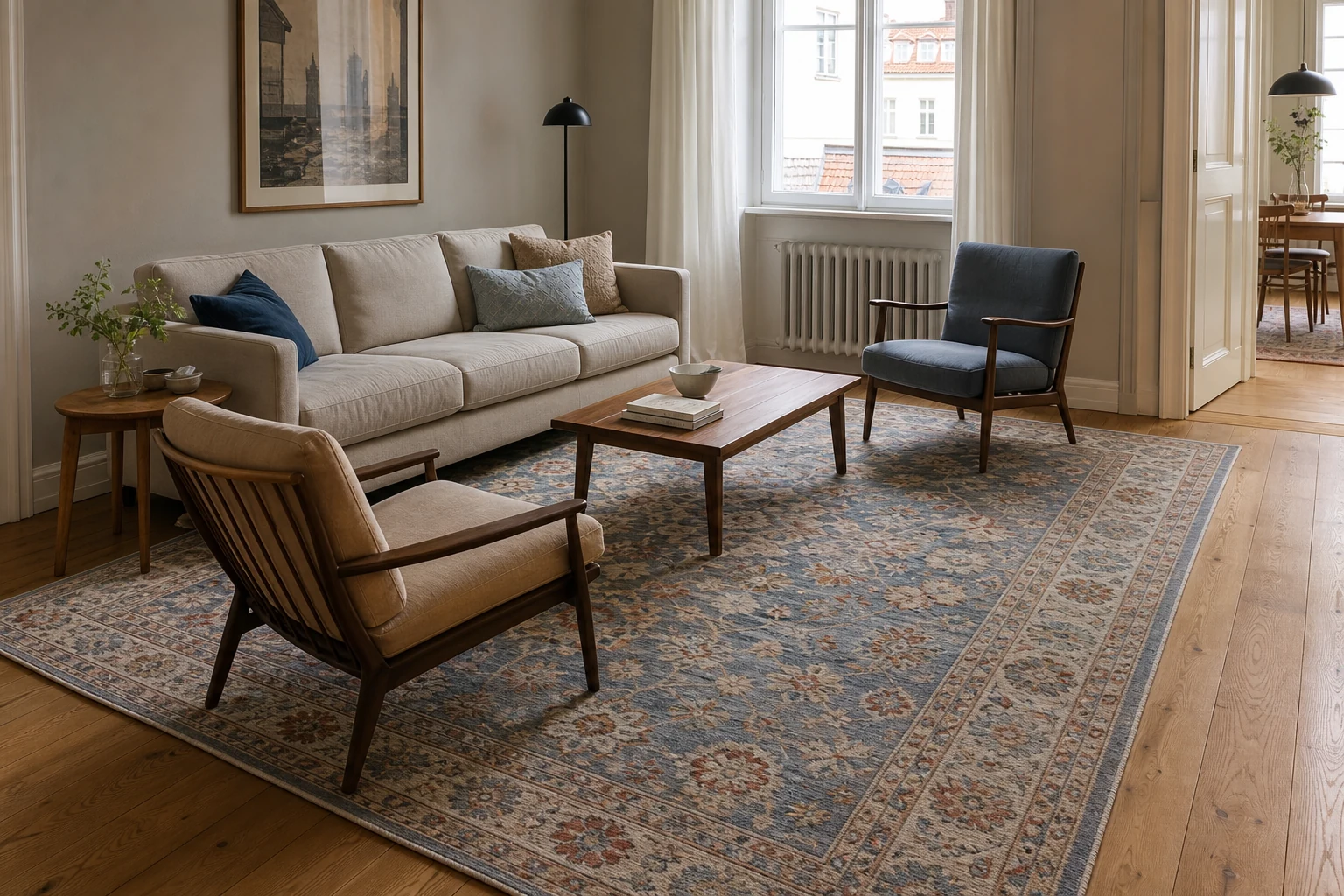
A living-room rug should connect the seating group, not merely fill the space beneath the table. Stable contact with the principal furniture gives the zone a clear boundary.
4. Each room needs a different practical check
| Room | What the rug should connect | Test before buying |
|---|---|---|
| Living room | Sofa, chairs and coffee table | Main front legs stand securely on the surface and the edge avoids the busiest route |
| Dining room | Table and every chair | Pull each chair into a normal position; all feet should remain on the rug |
| Bedroom | Bed and the areas where feet land | Check the genuinely visible area beside and beyond the foot of the bed |
| Hallway | Direction of travel and the axis of the space | Open every door and verify pile clearance and stable corners |
| Open plan | One clearly defined functional zone | View it from the main entrances and ensure it divides space without blocking circulation |
5. Let shape follow the furniture geometry
A rectangular rug naturally supports a long sofa, dining table and lengthwise room axis. A square or nearly square format may better suit a compact seating group. A round rug can work beneath a round table or in an entrance hall when there is enough space around it and no conflict with doors.
You do not have to copy the room shape blindly, but the rug should have a clear relationship with the furniture. In a narrow room, the wrong orientation can emphasise confinement. With a directional design, also decide where the drawing should be read from: the entrance, the sofa or the main view through the room.
6. Compare colours with fixed materials
Start with the floor, large sofa, timber, stone and curtains. Do not search for an exact match; look for a shared undertone and balanced temperature. Warm ivory, cool greige and pinkish sand may all be labelled beige in a catalogue yet behave very differently beside your oak or stone.
A practical method is to bring a small real sample of fabric, timber or paint to the rug. From an expressive rug, choose one quiet tone for larger surfaces and one or two secondary colours for smaller accents. There is no need to repeat every pile colour in cushions; matching too precisely can make the result feel flat and contrived.
A phone photograph helps with the broad impression but is not a reliable colour reference. Automatic white balance, display settings and ambient light all shift colour. Make the final judgement from the physical rug and actual materials, ideally under light similar to your home.
7. Adjust the amount of pattern to what is already present
In a calm room, dense Persian ornament can add depth and crafted detail. Beside strongly veined stone, large wallpaper and patterned upholstery, an open composition or a restrained tonal drawing may work better. Patterns do not need to resemble one another, but one should have a clearly leading role.
Consider furniture coverage. A central medallion may almost disappear beneath a solid coffee table or bed. An all-over repeat tolerates partial coverage more easily. On a modern rug, check that the visible crop still contains its important colour relationship and does not look accidentally cut off.
8. Fibre and pile height must suit the use
A sound hand-knotted wool rug is often a good choice for a regularly used living room when its construction and pile suit the traffic. Fine silk, high relief or a very old piece belongs in a calmer zone where it will not be repeatedly stressed by outdoor shoes, castors or moving chairs.
A more even surface is practical beneath a dining table because chairs move predictably across it. In a home with pets, inspect fringe length and loose elements that may invite play. If you use a robot vacuum, have low-clearance doors or underfloor heating, verify the total height and underlay suitability before buying.
9. Light and pile direction can change the result
Pile reflects light according to its direction. The rug may therefore look richer and darker from one end and lighter and quieter from the other. This is not a fault but a normal characteristic of a pile surface. View the rug from both directions in the showroom and turn it where space permits.
Prolonged direct sun can change colours unevenly over time. Observe the path of light near large windows and plan for blinds, curtains or periodic rotation. Very warm or cool artificial light also changes the perception of reds, blues and neutrals, so compare the result by day and evening.
10. In a dining room, measure chair movement rather than only the table
A dining rug is not sized solely from the length and width of the tabletop. The decisive area is the one occupied when a chair is pulled back for normal use. If its rear feet drop off the rug, the chair catches the edge as it returns, stresses the textile and feels uncomfortable.
Pull every chair back as far as you genuinely use it and measure the outline of that position. With an extending table, include its extended arrangement. The rug and tabletop need not have exactly the same shape at any cost, but the table and all working chairs should read as one stable group.
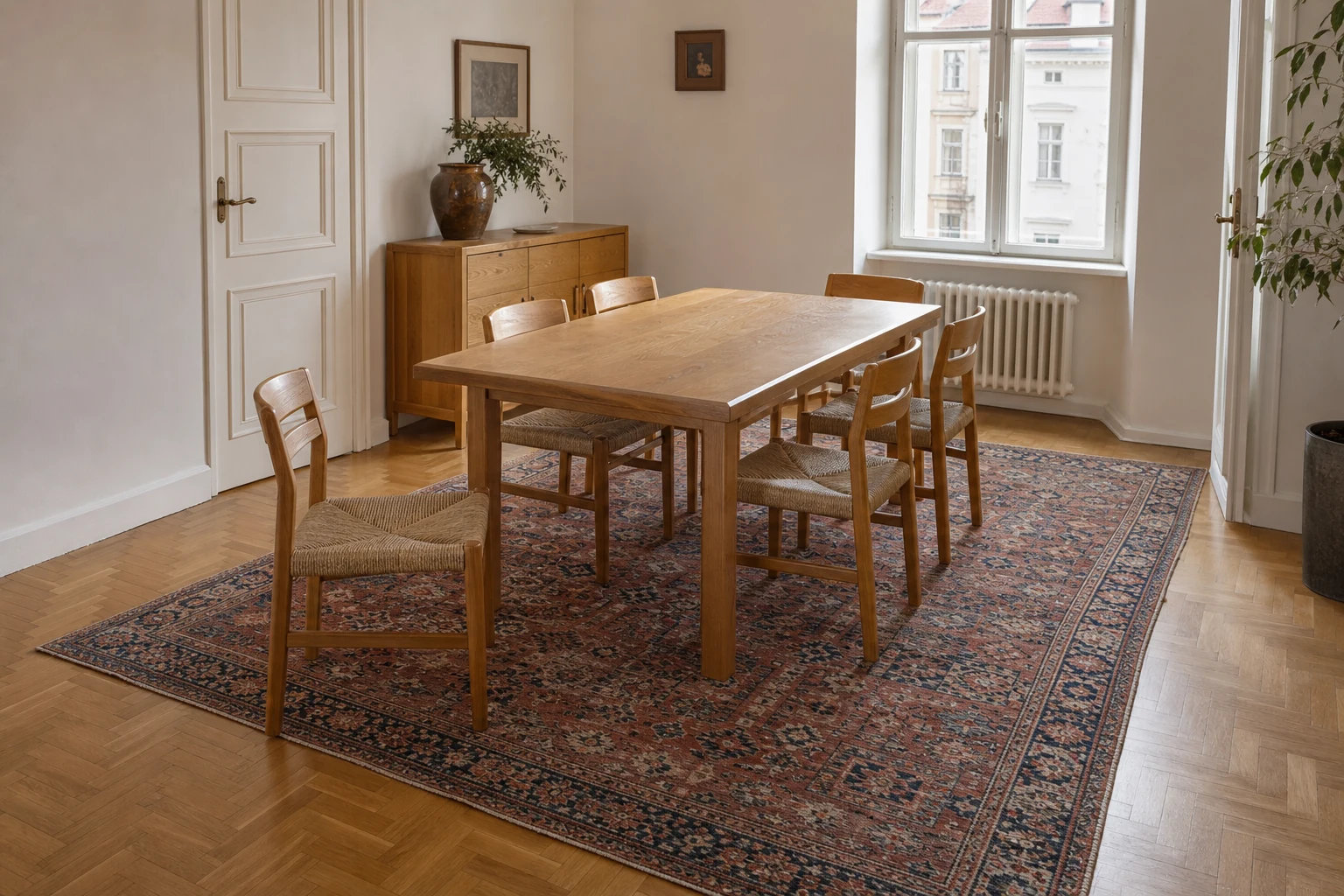
In a dining room, the right dimensions are proven in movement rather than a static photograph. A chair should remain on the rug when pulled back.
11. Multiple rugs in an open plan need not match
In an open living and dining area, two rugs can define separate functions. They do not need the same pattern or collection. It helps when they share at least one quality: related colour temperature, fibre, contrast level or density of drawing.
Do not force two nearly identical but visibly different shades into a false pair. Intentional contrast is often more convincing — perhaps one ornamental rug and one quieter design — with enough visible floor between them. Each must also suit the traffic of its own zone.
12. Include the underlay from the beginning
A suitable underlay reduces movement, distributes pressure and may improve comfort. It must be compatible with the floor, rug dimensions and any underfloor heating. It should not protrude, create ridges or become sticky or crumbly with age.
Include its thickness when checking doors and thresholds. The rug and underlay should lie calmly and evenly; lifting corners are not only untidy but a trip risk. With a valuable floor finish, confirm that the pad material is appropriate for its surface.
What to bring to the showroom
- Exact dimensions of the zone and principal furniture.
- Photographs from several corners in daylight.
- A small sample of an important fabric, timber or paint where available.
- Information about children, pets, underfloor heating and traffic level.
- An idea of which areas will be covered by a table, sofa or bed.
Have the rug opened out completely and view it close up and from several metres away, from both pile directions. Place samples directly beside the edge, photograph the full composition in neutral light and always compare the exact size you are considering, as pattern proportions may change between formats.
Common mistakes
- choosing colour before resolving dimensions and door clearance,
- a coffee-table-sized rug in the middle of a large seating group,
- dining chairs that drop off the edge when pulled out,
- trying to repeat every rug colour exactly in accessories,
- judging colour only on a phone or under one type of light,
- concealing the medallion or decisive part of a modern composition,
- selecting a delicate fibre for traffic it was not made to handle,
- forgetting underlay height, door swing and the main walking route.
A well-matched rug does not look like a final accessory placed into a completed room. It creates the foundation, connects individual pieces of furniture and gives colours and materials a common context. Browse all Carpeteria rugs or visit our Prague 5 showroom with photographs and measurements of your space. We can open specific pieces, compare pile direction and help you test the crop that will remain visible beneath furniture.