
Advice and inspiration
Where to buy a genuine hand-knotted Persian rug in Prague?

You can buy a genuine hand-knotted Persian rug in Prague at the Carpeteria showroom at Nádražní 39/76, 150 00 Prague 5 – Smíchov, or online at Carpeteria.cz. More important than the address alone is how the seller describes each rug: you should receive the country of origin, materials, dimensions, technique and condition, with access to both the face and reverse.
Buying a hand-knotted rug is not simply choosing a colour from a photograph. Every piece may differ in drawing, pile height, fineness, direction, tonal variation and character. A good seller should not push you towards the most expensive option, but help compare several correctly sized rugs and explain differences that are easy to miss at first glance.
What a genuine Persian rug actually means
The term Persian rug refers to origin in Iran, historically known as Persia. A “Persian design” or “Persian style” may be made in another country and is not the same as Persian origin. A rug can likewise be hand-knotted but come from Afghanistan, Pakistan, India, Turkey, the Caucasus or another important weaving region.
Hand-knotted pile is formed from individual knots tied around the warp, secured by wefts. The reverse therefore reveals the knot structure and mirrors the face design at lower contrast. Knot type alone does not determine country: both symmetrical and asymmetrical knots are used in different regions. Reliable attribution combines structure, materials, finishes, drawing, colour and documented information from the supply chain.
Why visiting a specialist showroom helps
A showroom reveals differences that a phone display conceals. The colour of a hand-knotted rug changes with pile direction and incident light, fine ornament blends when viewed from a distance, and dimensions feel different in space than they do in a product photograph.
- compare several rugs side by side in the same light,
- see the entire face, reverse, side edges and fringe,
- feel the actual softness, density, height and direction of the pile,
- check whether the rug lies flat and has undisclosed repairs or stains,
- discuss size, rug pad, care and furniture placement,
- receive information about the individual piece rather than a generic collection description.
Bring a floor plan or exact room measurements, several daylight photographs and, if useful, a sample of flooring, fabric or wall colour. Mark the positions of the sofa, dining table and doors. This makes selection faster and greatly reduces the chance of choosing the wrong size.
How to recognise hand-knotted construction
Start with the reverse. On a hand-knotted rug, the individual knots and design remain visible from the back; small irregularities may be evidence of hand work rather than defects. A machine-made rug usually has a highly regular industrial backing, sometimes with an applied layer, and its decoration may not form part of a hand-tied knot structure.
Examine the fringe too. On a traditionally hand-knotted rug, it is normally the continuation of the foundation warps on which the rug was built, not a separate decorative strip sewn to a finished edge. Some genuine rugs have shortened, secured or professionally repaired fringe, so never rely on one feature in isolation.
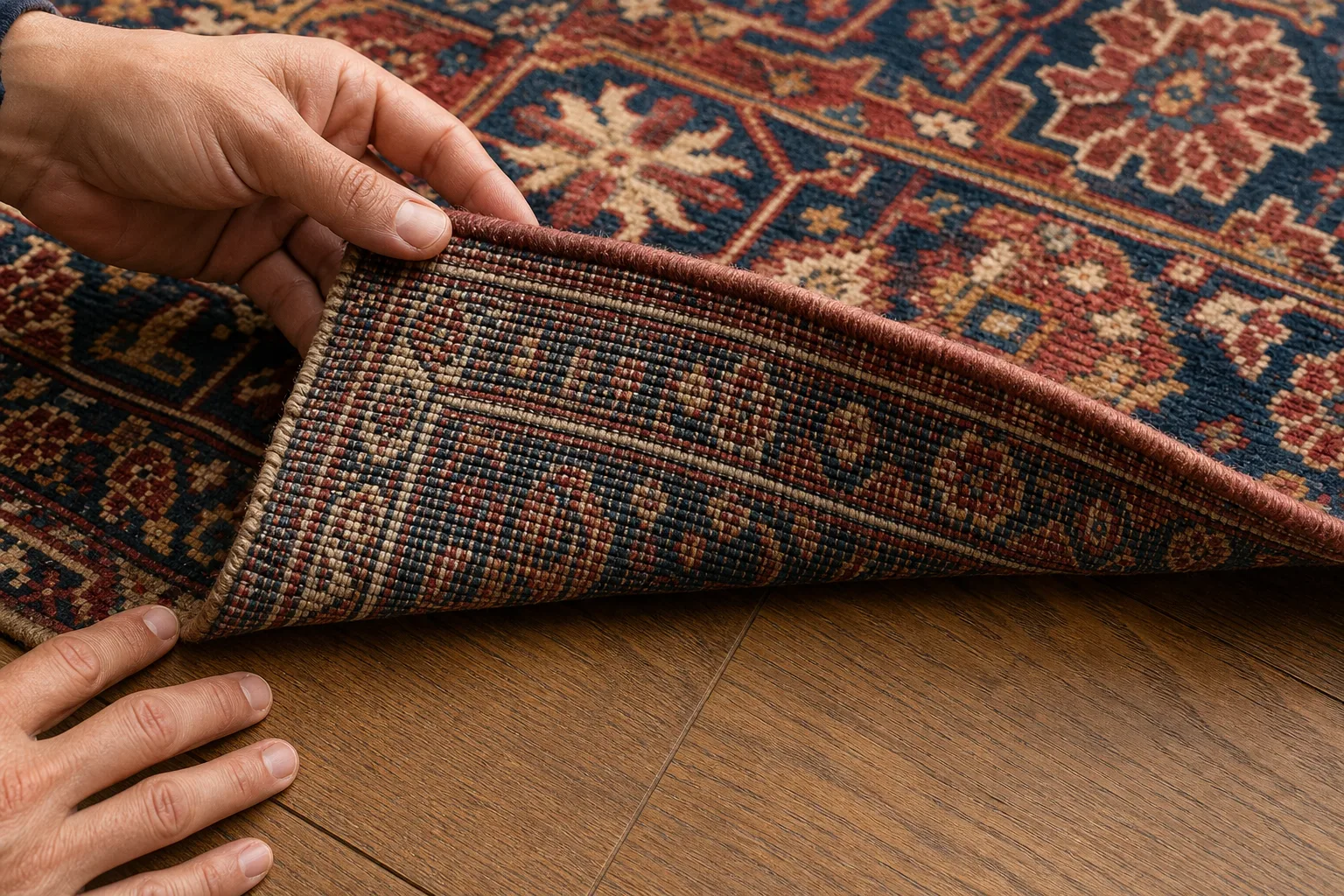
The reverse reveals construction, density, colour changes and some repairs. The seller should let you lift an edge and explain what you are seeing.
Questions to ask the seller
| Question | What the answer should include | Why it matters |
|---|---|---|
| Where was the rug made? | Country of origin and, when known, region, city, workshop or weaving tradition | “Oriental” or “Persian style” is not a precise origin |
| Is it genuinely hand-knotted? | Access to the reverse, knot structure, warp, weft and finishes | A marketing label does not replace physical inspection |
| What is it made from? | Pile, warp and weft materials, such as wool, cotton or silk | Materials affect appearance, durability, care and price |
| What is the exact size? | Length and width excluding fringe, measured for that individual piece | A handmade rug may not be perfectly rectangular |
| Is it new, older or restored? | An open description of wear, stains, reductions, repairs and previous cleaning | Condition may affect use and value more than knot count |
| What are the purchase terms? | Documentation, delivery, exchange or return options and complaint procedure | You can decide without unnecessary pressure or uncertainty |
What really affects the price
The price of a hand-knotted Persian rug reflects several factors: origin, materials, wool or silk quality, fineness and confidence of drawing, colour, size, age, condition, rarity and current demand. Knot count is useful technical information, but it is not a complete quality grade.
A bold village rug with lower density may be artistically or culturally more interesting than a very fine but unremarkable piece. Likewise, not every old rug is valuable and not every silk rug is the best choice for a busy living room. A seller should explain the price of the individual rug without promising a “guaranteed investment”.
Choosing a rug for a real room
Begin with function. In a living room, the rug may unite the whole seating group or sit only beneath the front legs of sofas and chairs. Under a dining table it needs enough margin for chairs when pulled out. In a bedroom, decide whether the rug should frame the whole bed or simply provide soft areas at the sides.
Then consider traffic. A fine silk or collectible piece is better suited to a quieter zone, while a good wool rug normally handles ordinary family life more comfortably. A dark dense pattern conceals minor dirt, whereas a light open field can make a small space feel larger. Also check door clearance, the rug pad and any underfloor heating.
Buying online: what the product page should show
Online purchase requires more than one styled photograph. Look for the whole face, a pile close-up, a large clear view of the reverse, fringe, side edges and every significant area of wear or repair. Dimensions must belong to the individual rug, not only to a model range.
You can also shop online at Carpeteria.cz; the website states free delivery within the Czech Republic and 30 days for exchange or return. Before ordering, read the current terms, stock status and delivery method for the specific size. For a more valuable or unusual rug, request additional photographs and advice about placement.
Warning signs when buying
- the seller refuses to show the reverse or provide a sharp photograph of it,
- “Persian”, “Oriental” and “handmade” are used as interchangeable terms,
- the exact material, country of origin, dimensions or condition are missing,
- one small irregularity is presented as the only proof of hand-knotting,
- a high knot count is claimed to guarantee the best quality,
- certain appreciation or an unusually high future value is promised,
- you are pressured to buy immediately without comparison or clear terms.
Carpeteria showroom in Prague 5
The showroom is at Nádražní 39/76, 150 00 Prague 5 – Smíchov. Current contact information lists opening hours as Monday to Saturday 10:00–18:00 and Sunday 11:00–17:00; check the contact page before a longer journey.
The nearest connections are Metro B Anděl, using the Na Knížecí exit about 350 metres away, Metro B Smíchovské nádraží about 600 metres away, or the Na Knížecí tram stop. The surrounding streets use mixed paid parking; free on-site parking is possible by prior arrangement.
Bring room measurements and photographs. At the showroom we can demonstrate the difference between Persian origin and Persian style, compare construction, materials, colour and condition, and help select a rug that suits the space, daily use and budget.