
Advice and inspiration
What is the difference between a Persian and an Oriental rug?

The short answer: every genuine Persian rug can be described, in the historic trade sense, as an Oriental rug, but not every Oriental rug is Persian. The word Persian identifies the country of origin: the rug was made in present-day Iran, formerly known as Persia. Oriental is a much broader umbrella term and does not identify one particular country.
The main difference is therefore not pattern, colour or quality. It is origin. A Turkish, Caucasian, Afghan, Indian or Chinese rug may belong to the broad category of Oriental rugs, but it should never be sold as Persian merely because it resembles an Iranian design.
A Persian rug is made in Iran
The label Persian rug is based on the country of manufacture. Iran has an exceptionally rich and varied rug tradition: alongside urban workshops are village, nomadic and tribal centres of production. Names such as Tabriz, Kashan, Isfahan, Nain, Heriz and Kerman commonly refer to a city, region or trading centre associated with a type of production. This does not mean that all Persian rugs look alike.
An urban workshop piece may have a fine foundation, precisely drawn medallion and high knot density. A village or tribal rug may be more robust, geometric and deliberately less regular. Both may be authentically Persian. The determining fact is the supported place of manufacture, not fineness or a particular motif.
Oriental rug is an umbrella term
In European collections and the rug trade, Oriental rug has historically been used for pile-woven and other handmade rugs from a vast area of western, central, southern and eastern Asia and neighbouring regions. It can therefore place very different traditions under one label:
- Iran: Persian urban, village, nomadic and tribal rugs.
- Anatolia and Turkey: regional rugs with a strong tradition of symmetrical knots and both geometric and floral compositions.
- The Caucasus: often associated with bold geometry, but encompassing many local variations.
- Afghanistan and Central Asia: tribal and workshop traditions with differing structures and palettes.
- India and Pakistan: historic court carpets as well as contemporary workshop production.
- China and other parts of East Asia: traditions with their own materials, symbolism and construction methods.
For an individual piece, it is therefore more useful to name the country, region, production tradition and approximate period. Oriental remains useful as a broad category, but on its own gives a buyer little verifiable information.
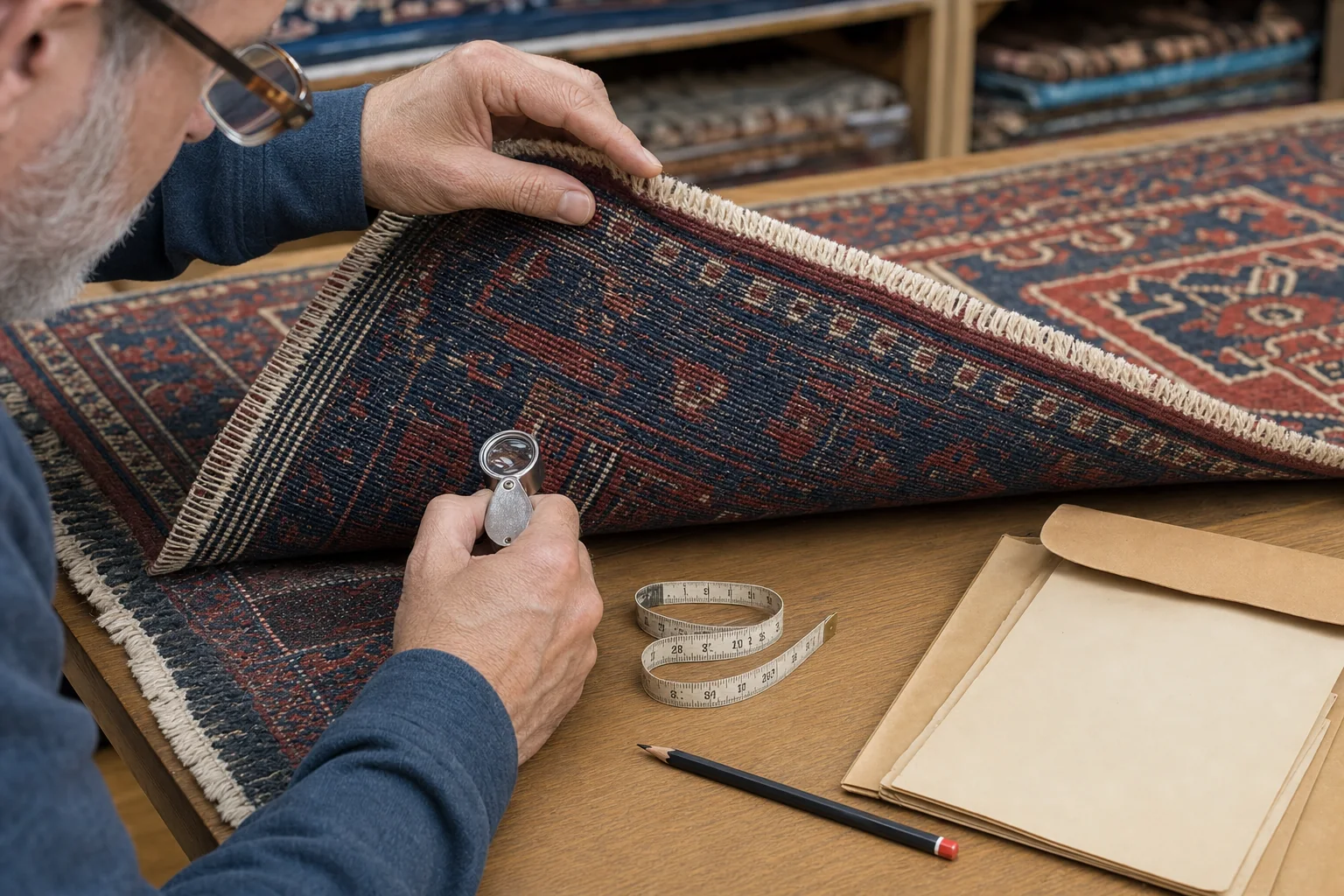
Origin is not identified from one motif. A specialist compares the face and reverse, structure, materials, colours, finishes and known history of the rug.
A pattern does not identify the country
A medallion, palmette, tree of life, boteh or geometric star is not a reliable passport for a rug. Motifs travelled for centuries between courts, workshops, trade routes and neighbouring communities. Successful compositions were copied and adapted, and many traditional patterns are now also made outside the place with which they are most closely associated.
A rug made in India from a Persian design should, for example, be described as an Indian rug in the Persian style, not as a Persian rug. Persian design describes appearance; Persian rug describes origin.
Knot type is not a passport either
Technical descriptions often distinguish the asymmetrical knot, sometimes called Persian, from the symmetrical knot, also called Turkish. These names are convenient structural shorthand, not proof of where a rug was made. Asymmetrical knotting is used beyond Iran, while symmetrical knotting also appears in some Iranian weaving areas.
Knot type is an important part of identification, but it must be read alongside the foundation material, number of wefts between knot rows, side finishes, fringes, pile clipping, dyes and overall structure. No single feature is enough.
What materials and construction can reveal
The reverse often says more than the face. It reveals knot arrangement, regularity, repairs and whether the fringes continue from the warp or have been attached later. Materials can help narrow the possibilities: wool pile on a cotton foundation is common, but all-wool, silk and mixed structures also exist.
No material belongs exclusively to one country. Silk does not automatically mean Persia, high knot density does not determine quality by itself and irregularity is not automatic proof of age. Identification comes from assembling several consistent clues.
The labels at a glance
| Label | What it precisely means | What it does not guarantee by itself |
|---|---|---|
| Persian rug | A rug made in Iran | A particular design, age, handmade construction or high quality |
| Oriental rug | A broad historic category covering several countries and traditions | An exact country, region, material or value |
| Persian-style rug | A piece inspired by a Persian composition or motif | Manufacture in Iran |
| Regional name | A stated connection with a city, area or weaving tradition | Authenticity without supporting structural and documentary evidence |
How to verify the origin of a particular rug
- Ask for an exact written description. The invoice should state the country of origin and, where possible, the region or tradition, materials and approximate age.
- Ask what supports the attribution. A responsible dealer can explain construction, materials, knot type and other features, rather than relying only on a pattern name.
- Examine the reverse and finishes. The back shows structure and repairs; the ends and sides may reveal construction details and later interventions.
- Separate origin from style. Phrases such as “Persian design”, “Oriental style” or “Tabriz pattern” are not the same as a confirmed country of manufacture.
- Seek specialist assessment for a valuable piece. An independent expert and documented ownership history are worthwhile, especially when great age, a rare region or collector provenance is claimed.
Is a Persian rug automatically better?
No. Iran has produced many exceptional rugs and its regional traditions are among the world's most important, but a geographical name is not a quality grade. Excellent and ordinary pieces are made in many countries. The quality of an individual rug depends on appropriate materials, a sound and balanced structure, the quality of the wool or silk, drawing, dyeing, finishing, condition and suitability for its intended use.
Knot count also needs context. Fine pictorial drawing requires a different density from a durable tribal rug with large geometric motifs. A higher number is not always better, and a simple traditional piece is not necessarily less valuable.
What description should appear on the invoice?
A good trade description is specific and separates known facts from expert opinion. It might read: “hand-knotted rug, Iran, Heriz region, wool on cotton, approximately second half of the twentieth century”. If an attribution is uncertain, the wording should acknowledge that with terms such as “probably”, “attributed to the region” or “in the style of”.
When buying, do not ask only whether a rug is Persian or Oriental. Ask where it was made, how it is constructed, what supports the attribution and whether that information will appear on the paperwork. A precise description protects the buyer better than an impressive but overly general label.
At the Carpeteria showroom in Prague 5, we will gladly show you these differences on real rugs — from the face and reverse — and explain which features support the attribution of a particular piece.