
Advice and inspiration
What is a hand-knotted rug and how is it actually made?

A hand-knotted rug is a pile textile made on a loom by tying short lengths of coloured yarn around tensioned warp threads. The ends of every knot project towards the face; once clipped, they form the pile and the image at the same time. One or more wefts pass between rows of knots and bind the construction together.
“Hand-knotted” therefore describes a particular method of manufacture, not a style, country or automatic guarantee of quality. It may describe a fine urban Persian carpet, a coarser village rug, a Turkmen weaving, contemporary Indian production or a French Savonnerie. Quality must be judged through materials, structure, execution, design, colour, finishing and the condition of the complete piece.
Three components: warp, weft and pile
The warps are the lengthwise threads stretched between the loom beams. They form the rug's skeleton, and their free ends frequently continue as fringe. The wefts travel across the width, alternately between warps, stabilising and connecting them after each row of knots.
The pile is made from supplementary coloured yarn tied around adjacent warps. A knot is tightened, its ends cut and later clipped to a common height. Thousands or millions of these ends create the soft surface, colour and drawing.
The structure works as one system. Very fine yarn is of little use if warp tension is erratic; a high knot count cannot compensate for weak sides, and an attractive face does not redeem a brittle or damaged foundation.
How a rug grows on the loom step by step
- Design and material preparation: dimensions, colours, yarns and a method of reading the design — cartoon, sampler or memory — are selected.
- Warping the loom: warp threads are run evenly over a vertical or horizontal loom. Their spacing influences fineness and dimensional accuracy.
- Foundation weaving: a flatwoven band often establishes and strengthens the first end of the future rug.
- Tying a row: the weaver knots coloured pile yarn around pairs of warps according to the design.
- Inserting weft: one or more weft passes follow the row of knots.
- Beating: a comb-like tool compacts knots and wefts into a firm structure.
- Progressive clipping: excess pile is levelled so that the next part of the pattern remains legible.
- Finishing: after removal from the loom, ends and sides are completed, the pile is finally clipped, and the rug is professionally washed and straightened.
Several people may work simultaneously on a wide carpet. Differences in working rhythm, tension or where discontinuous wefts meet can leave small structural traces on the reverse. They are not automatically defects; they can help reveal how the piece was made.
Symmetrical and asymmetrical knots
The two most common pile-rug knots are symmetrical and asymmetrical. In a symmetrical knot, yarn encircles two warps in the same way and both ends emerge between them. An asymmetrical knot wraps one warp fully and the second only partly, and may be open to the right or left.
Older literature calls the symmetrical structure “Turkish” or “Ghiordes” and the asymmetrical structure “Persian” or “Senna”. Encyclopaedia Iranica cautions that these geographic labels are misleading: both types occur across the Near and Middle East without a simple relationship to national borders, language or the weaver's ethnicity.
Neither knot is inherently superior. What matters is its suitability for the intended drawing, material and local tradition, and the consistency of its execution. Economical variants tied over more than two warps also exist; they can accelerate production but usually reduce knot density and the ability to render fine detail.
Materials used in hand-knotted rugs
Sheep's wool is the most common pile material. Good carpet wool is resilient, recovers from compression and provides a comfortable surface. Its quality varies with the part of the fleece, breed, processing, fibre length, twist and the amount of short or dead fibre.
Silk permits very fine drawing and changes its reflection with pile direction. It may form the whole pile, selected highlights or the warp and weft of a luxury rug. It is more sensitive to abrasion, moisture and unsuitable cleaning, so not every silk rug belongs in a busy room.
Cotton commonly forms the warp and weft of urban rugs because it makes a regular, dimensionally stable foundation. Wool foundations occur in village and nomadic traditions. A material name alone does not establish quality; its grade, suitability and handling matter.
Design can come from a cartoon, sampler or memory
Workshop production often uses a cartoon — a design drawn on squared paper, with each cell corresponding to a knot or small group of knots. The weaver reads colours and motif boundaries row by row. On extremely fine carpets, this system supports complex curves, inscriptions and figural drawing.
Another method uses a knotted sampler containing sections of field and border. Village and nomadic makers may work from memory and a local repertoire, adapting motifs to the actual width as they proceed. The resulting small irregularities are not simply failures of precision; they may be a direct record of decisions at the loom.
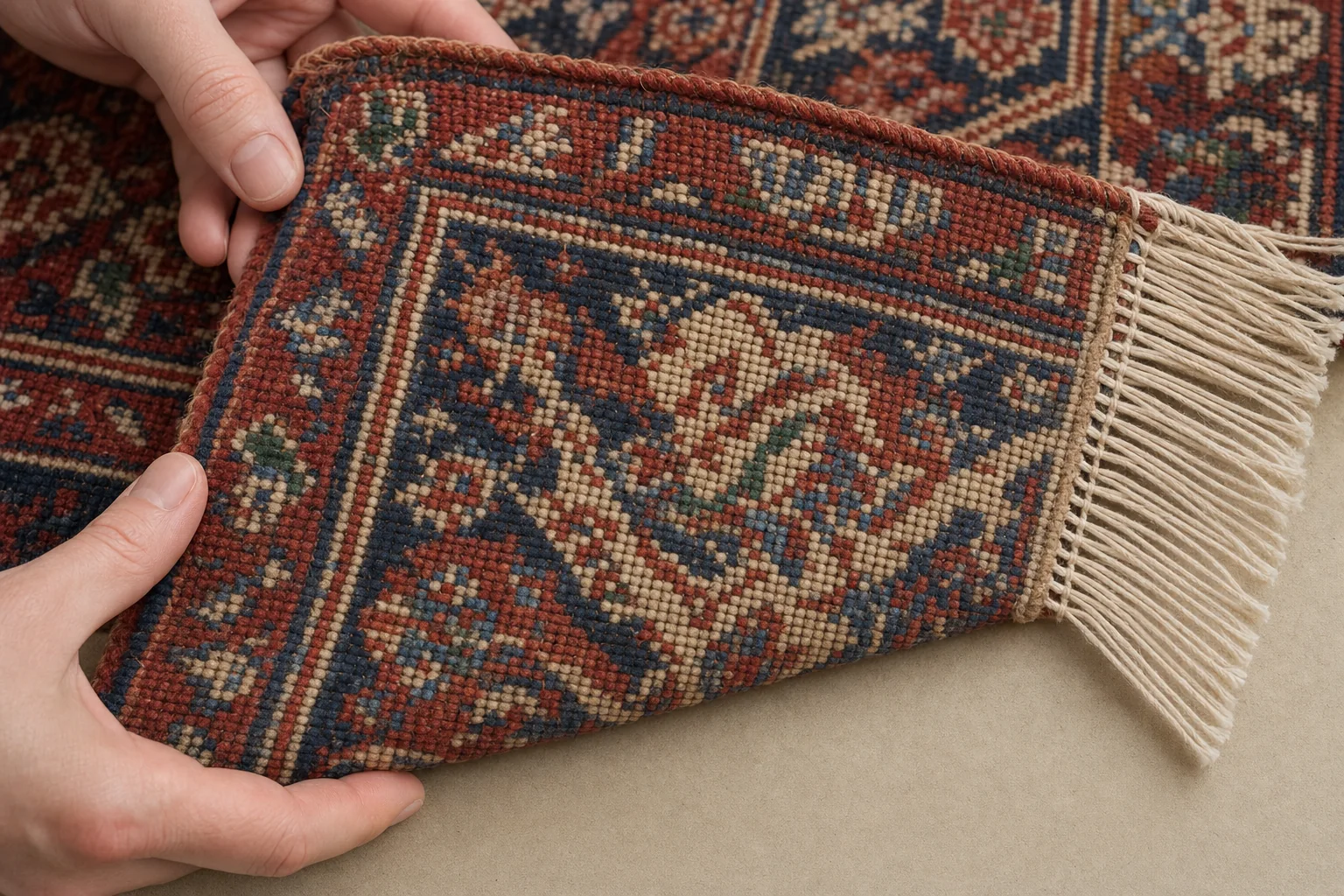
Face and reverse are two sides of the same structure. The pattern appears in knot nodes on the back without an adhesive cover, while warp threads generally continue into the fringe.
What knot density really tells you
Knot density records how many knots occupy a given area. A higher density can enable smaller curves, finer contours and more detailed drawing, much as a finer image grid can hold more detail. It is not a universal quality ranking across every weaving tradition.
Thick hand-spun wool and a bold geometric design naturally require fewer knots than a silk pictorial carpet. A coarser but well-compacted village rug may be structurally excellent and artistically convincing. Conversely, a very high count of tiny knots cannot rescue brittle yarn, poor tension, weak dyes or damaging chemical finishing.
When comparing figures, check whether the seller states knots per square centimetre, decimetre or inch, and whether individual knots are counted rather than colour points or both halves of one knot.
How to recognise hand knotting on the reverse
Turn one corner over on a clean surface. On a hand-knotted rug, the design is normally recognisable on the reverse as a grid of individual knot nodes. It is not concealed by a latex layer or secondary cloth backing. The finer the construction, the more clearly contours may appear on the back.
Fringes are generally continuations of the warp rather than a separately sewn decoration. Examine the sides as well, where several warps are commonly overcast into a firm selvedge. Modest variations in width, tension or drawing can belong naturally to manual work.
These signs are not absolute. An old rug may have a protective repair lining, replaced fringe or covered areas on its reverse. On an expensive piece, combine structural examination with documentation, provenance and specialist assessment.
Hand-knotted is not the same as hand-tufted
In a hand-tufted rug, yarn is pushed with a handheld gun or needle through a prepared primary cloth. The loops may be cut to form pile, but they are not tied progressively around warps. Adhesive is normally applied to the reverse and covered by a second textile so that the yarn remains in place.
Tufting is faster and supports accessible, emphatic contemporary designs. It is not a “fake rug”, but a different construction that ages differently. Adhesive can harden or crumble with time, while repairs follow a different process from those on a knotted piece.
The word “handmade” is not decisive because a hand-tufted product also involves manual work. Ask specifically for hand-knotted construction and inspect the reverse.
Difference from a kilim and a machine-made rug
A kilim is a flatweave without continuous cut pile. The design is formed by wefts interlacing the warp, often with characteristic slits between colour areas. It is lighter, more reversible and technically no less valuable; it simply works differently from a pile rug.
A machine-made rug is produced on powered equipment that repeats structure and design at high speed. Its reverse is usually extremely regular and may involve different warp, weft, adhesive or synthetic-backing systems. Machine manufacture is not automatically poor, but it does not contain individually hand-tied knots.
Hand-woven is a broader term than hand-knotted. It may describe a kilim, another flatweave, soumak, a hand-tufted product or a different textile method. Always ask for the precise construction.
What determines the quality of a hand-knotted rug
- Materials: fibre length, resilience and cleanliness, and the suitability of wool, silk or cotton for the intended use.
- Structure: even warp tension, correctly managed wefts and a firm but not brittle handle.
- Knot execution: density and tightness consistent with the design.
- Drawing: confident proportions, legible borders and purposeful simplification of motifs.
- Colour: a coherent palette, sound dyeing and suitable fastness; natural dye origin is not the only measure.
- Finishing: even pile clipping, stable sides and ends, and no masking chemical treatment.
- Condition: wear, old repairs, weakened foundation, stains, insects and previous cleaning.
Handmade irregularity and a practical defect are different things. A slight shift in a motif can be engaging evidence of the maker's hand; severe buckling, a breaking foundation, failing sides or colour that migrates in professional testing are real problems.
Why production takes time and prices vary
Every row requires colour selection, knot tying, weft insertion and beating. Production time therefore increases with area, density, design complexity and material fineness, and may decrease when several people work across a wide loom. An exact number of months cannot be derived from size alone.
Price covers materials, yarn preparation and dyeing, design, time at the loom, workshop management, clipping, washing, transport and trading costs. Two hand-knotted rugs of equal dimensions may contain very different structures and quantities of labour.
A higher price is not automatic proof of origin or quality either. Ask for an exact description of pile and foundation materials, technique, country or region of manufacture, dimensions, condition, repairs and return terms.
Is every hand-knotted rug durable?
A sound wool rug with good construction can last a very long time in appropriate use, and local damage can often be repaired at the level of knots, warps and edges. Durability is not, however, inherent in the label “hand-knotted”.
Fine silk, a high soft pile, chemically weakened yarn, unstable colour or an old brittle foundation all demand gentler use. Match placement to material and condition: firm wool may suit a living room, while a fine collector's piece belongs in a quieter zone.
A suitable non-slip underlay, periodic rotation, gentle vacuuming without a rotating power head, protection from sustained direct sunlight and prompt blotting of spills all help. Entrust deep cleaning to a specialist in hand-knotted rugs.
A quick construction comparison
| Construction | How the surface is made | Typical reverse | What to verify |
|---|---|---|---|
| Hand-knotted | Individual pile knots around warps, with wefts between rows | Visible knot nodes and design without an adhesive layer | Material, density, execution, condition and repairs |
| Hand-tufted | Yarn pushed with a gun through a primary fabric | Usually adhesive and a secondary textile cover | Adhesive type, pile material and expected lifespan |
| Kilim / flatweave | Warp and weft form the design without continuous pile | Flat and often clearly readable from both sides | Slits, edges, dimensional accuracy and fibre condition |
| Machine-made | A mechanically repeated woven, tufted or other system | Very regular; structure depends on technology | Composition, backing, density and finishing method |
What to check before buying
- Ask for the exact technique, not only the word “handmade”.
- View the whole face in natural light and from both pile directions.
- Fold one corner and inspect pattern, knots, wefts and any backing.
- Check whether fringe continues from the warp or was replaced in repair.
- Compare density and regularity in several places, not just one corner.
- Inspect sides, ends, buckling, odour, stains, insects and old interventions.
- Ask about pile and foundation materials, origin, age and cleaning history.
- Decide whether the structure suits the room and its actual traffic.
A hand-knotted rug is compelling because design and load-bearing structure develop together. Every knot adds one minute point of colour, but only warp, weft, tension, material and thousands of working decisions turn those points into a functional whole.
At the Carpeteria showroom in Prague 5, you can compare face and reverse, knot density, wool, silk and finishing across actual rugs. We can help distinguish construction from a trade label and select a piece for both quality and intended use.