
Advice and inspiration
What are the most famous types of Persian rugs?

Persian rugs do not belong to a single style. Iran has dozens of city workshops, village weaving areas and nomadic traditions, each with its own drawing, palette, materials and construction. Names such as Tabriz, Kashan and Heriz therefore help classify a rug, but they do not describe one fixed pattern reproduced identically every time.
A Persian rug is properly a rug made in Iran. Similar motifs are woven in other countries; those rugs may be excellent, but they should be described by their actual origin rather than called Persian solely because of their appearance.
City, village and nomadic rugs
City workshops often work from a detailed plan. Their rugs may have a finer weave, flowing curves, small flowers and carefully organised symmetry. Village and nomadic weavers traditionally rely more on memory and a shared repertoire of motifs, producing drawing that is often geometric, immediate and naturally variable.
This is a useful orientation, not a ranking of quality. A superb city rug can astonish through precision, while an exceptional tribal piece can be equally distinguished by wool, colour and compositional strength.
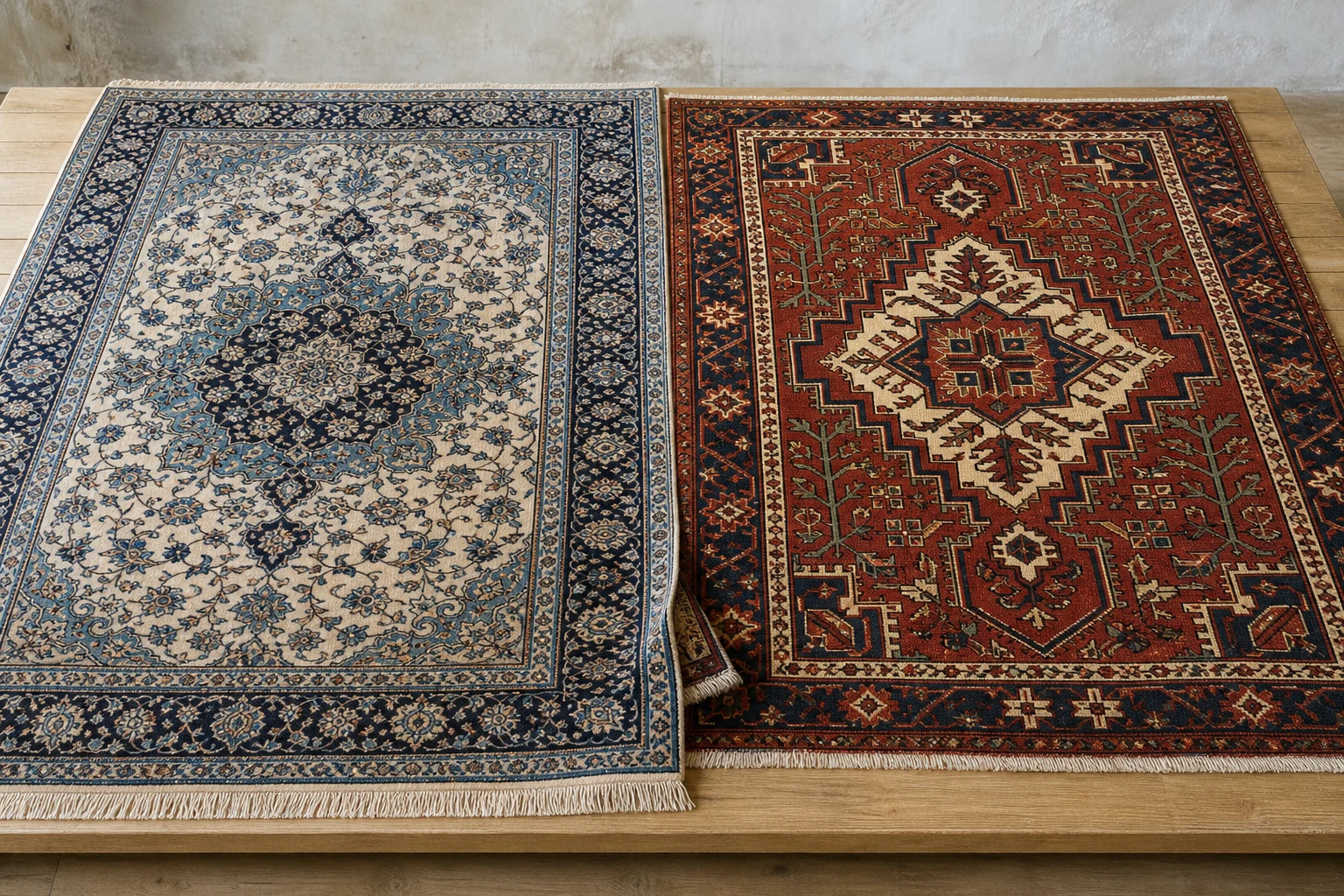
Fine curvilinear drawing and a strong geometric medallion are two different but equally valid languages of Persian weaving.
Tabriz: an exceptionally broad range of styles
Tabriz in northwestern Iran is one of the most important historic centres of trade and carpet production. Its rugs include classical central medallions, dense floral drawing, hunting and figural scenes, as well as more modern compositions. Palettes range from restrained to vivid, and construction ranges from practical room-size rugs to extraordinarily detailed workshop pieces.
Variety is itself characteristic of Tabriz. The name alone does not determine quality; materials, drawing, weave and the individual workshop still need to be assessed.
Isfahan: precision, elegance and fine arabesques
Rugs associated with Isfahan are commonly balanced and formal. A central medallion, fine scrolling vines, palmettes and flowers often appear on an ivory or dark-blue field. Good wool may be combined with silk highlights, and finer examples have precise drawing and a low, carefully clipped pile.
Isfahan suits interiors that call for a lighter, sophisticated accent and clear symmetry.
Kashan: classical floral composition
Kashan in central Iran is known for refined city rugs, often with a rounded central medallion, abundant flowers and a traditional combination of claret red, deep blue and ivory. Historic Kashan workshops, particularly rugs associated with the name Mohtasham, occupy an exceptional place among collectors.
Contemporary rugs described as Kashan can vary widely. Wool quality, clarity of colour, balance of drawing and edge finishing matter more than the name by itself.
Nain: a light palette and precise detail
Compared with older centres, Nain is a younger weaving tradition that developed during the twentieth century. Typical rugs use fine floral arabesques, a central medallion and an airy palette of ivory, beige, pale blue and navy. Silk outlines often highlight the design within a wool pile.
Nain is popular in quiet, light interiors. Number-based fineness terms used in the trade can be helpful, but ask what the designation means for the individual rug.
Qom: fine wool and all-silk rugs
Qom became an important production centre only in the twentieth century but quickly built a reputation for very fine work. Wool, wool-and-silk and all-silk rugs are made there, often in smaller formats. Designs include medallions, gardens, vases, trees of life and pictorial compositions.
The word Qom does not automatically mean silk. Confirm the pile and foundation materials of the individual rug.
Kerman: gardens, flowers and soft curves
Kerman in southeastern Iran is associated with rich floral drawing, garden designs, vases, trees of life and a broad palette. Older Kerman rugs may model flowers with great subtlety and depth, while later pieces often use generous medallions and more openly decorative layouts.
It is a useful tradition to explore when a room calls for a softer, more decorative and less geometric rug.
Heriz: the bold angular medallion
Heriz and surrounding villages in northwestern Iran are celebrated for robust wool rugs with a large diamond- or star-shaped medallion. The drawing is angular and energetic, commonly using brick red, indigo, cream and touches of green.
Strong wool and a commanding pattern make Heriz attractive for a frequently used living or dining room. As with every regional name, however, actual condition and construction still need to be checked.
Bidjar: compact, heavy construction
Bidjar, associated with the Kurdish area of western Iran, is known for dense, firm construction and rugs that feel notably heavy for their size. Designs may be geometric or floral and often include repeating Herati motifs, medallions, saturated red and deep blue.
A good Bidjar feels stable and durable, but its compact structure should not be sharply folded. Rolling is safer for moving and storage.
Qashqai and Gabbeh: traditions of southwestern Iran
Qashqai refers to a broad nomadic confederation in the Fars region. Its weaving traditions use good mountain wool, geometric medallions, small birds, animals and plants arranged with lively natural variation. Colours are often deep and the drawing highly personal.
Gabbeh belongs to the wider southwestern tradition and typically has a deeper pile, a more open field and sparse geometric or animal motifs. It looks relaxed and remarkably contemporary while growing from the long practice of pastoral communities.
A quick visual comparison
| If you want | Look especially at |
|---|---|
| Fine symmetry and a light palette | Nain, Isfahan or a fine Qom |
| A classical floral rug | Kashan, Tabriz or Kerman |
| A strong geometric centre | Heriz or selected tribal traditions |
| Compact, heavy construction | Bidjar |
| Freer, individual drawing | Qashqai or Gabbeh |
How to verify what you are buying
- ask for the country and region of origin, materials and approximate age in writing,
- examine the face, reverse, edges and fringes rather than relying only on a pattern photograph,
- do not identify origin by one colour or motif; popular designs are copied across regions and countries,
- ask whether the attribution is to a city workshop, village or nomadic tradition and what evidence supports it,
- choose for actual quality and the room rather than for a famous name alone.
Regional names are an excellent map, but they are not a substitute for examining the individual rug. Two pieces from the same area can differ in age, workshop, materials and quality, while different traditions may share a similar medallion or floral motif.
At the Carpeteria showroom in Prague 5, you can compare individual traditions side by side. We will gladly show you differences in drawing, reverse, pile and materials and help find a rug that fits both your interior and the way the room is used.