
Advice and inspiration
Prices of hand-knotted Persian rugs in the Czech Republic

A hand-knotted Persian rug may cost a few thousand Czech crowns, tens or hundreds of thousands, and exceptional pieces can cost more. This wide range is not arbitrary. Each rug is an individual object whose price reflects its size, materials, fineness and complexity of weave, region of origin, age, condition and rarity.
There is therefore no single correct “Persian rug price per square metre”. Two rugs of the same dimensions may require very different amounts of material and labour. A useful comparison begins only when the exact specifications of both pieces are known.
Indicative Persian rug prices in the Czech Republic
The following ranges are intended for initial budget planning, not as a fixed price list. Current availability, dimensions and the condition of the individual rug always take precedence over a general category, and consumer prices should be compared including VAT.
| Type of rug | Indicative price band | What it commonly includes |
|---|---|---|
| Small wool rug or runner | from a few thousand to the lower tens of thousands of CZK | Smaller formats, simpler village and tribal weaves, practical wool pieces |
| Medium room-sized wool rug | approximately CZK 20,000–80,000 | A broad choice of origins, designs and qualities for living, dining and bedrooms |
| Large or finely knotted wool rug | often CZK 50,000–200,000 and above | Large dimensions, better wool, finer drawing and more demanding production |
| Wool-and-silk or silk rug | tens to hundreds of thousands of CZK | Fine knotting, lustre, detailed drawing and more costly material |
| Exceptional old or collectible piece | individual valuation; may exceed CZK 1 million | Provenance, rarity, age, artistic quality and condition become decisive |
These bands overlap. A small, exceptionally fine silk rug can cost more than a large, robust wool piece. A lower price does not necessarily mean low quality either; it may simply reflect a smaller size, a less intricate design or a type made for hard everyday use.
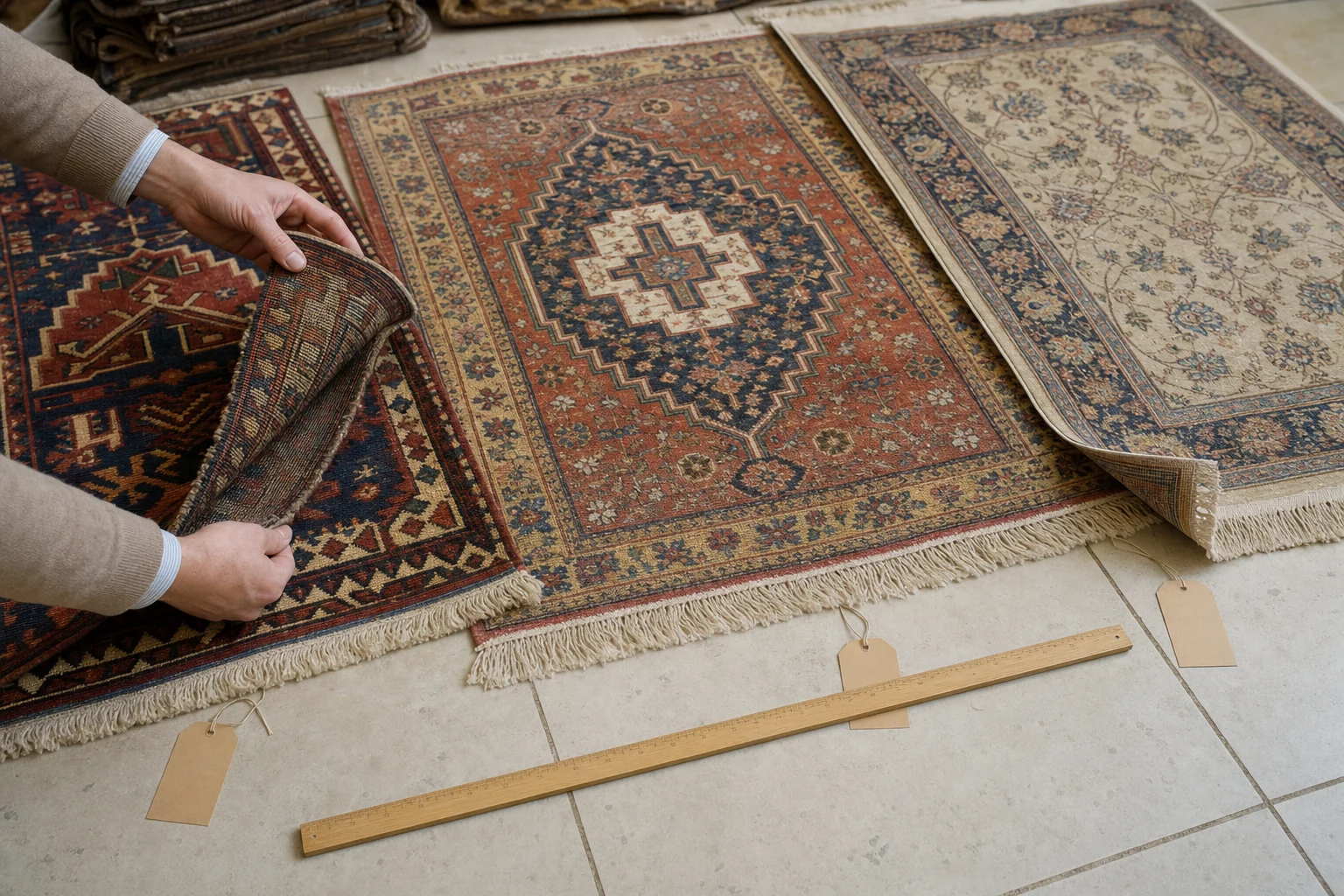
No single characteristic determines the price. Dimensions, materials, construction and condition need to be considered together.
1. Size: more area requires more material and labour
As dimensions increase, so do the number of knots, the quantity of yarn and the weaving time. Doubling both length and width produces four times the area, not twice the area. A large room-sized rug is therefore usually much more expensive than a smaller piece of the same type and quality.
Price per square metre is useful only when comparing similar rugs. A small, very finely woven piece may cost more per square metre than a large, more simply knotted rug. An unusual size or shape can also affect price because it may be more difficult to place in an interior.
2. Materials: wool, silk and combinations
Good wool is resilient, durable and practical in most regularly used rooms. Its cost depends on fineness, fibre length, preparation and the quality of spinning. The word “wool” alone does not describe the full quality.
Silk fibres are finer and allow more detailed drawing and a characteristic lustre. An all-silk construction, or a wool pile with silk details, usually increases both material cost and the labour required. Ask separately about the pile, warp and weft, as they need not be made from the same fibre. Viscose and other regenerated cellulose fibres are not the same as natural silk.
3. Knotting fineness and design complexity
A higher knot density allows finer curves, smaller motifs and more precise drawing, but it also takes longer to produce. Price therefore often rises with the fineness of the weave and the complexity of the design, particularly in city rugs from centres such as Tabriz, Isfahan, Nain or Qom.
Knot count is not a universal quality score. A robust Bijar, Hamadan or tribal rug may have fewer knots yet possess excellent wool, a strong structure and a long working life. Density is a technical specification that needs to be read together with materials, origin and intended use.
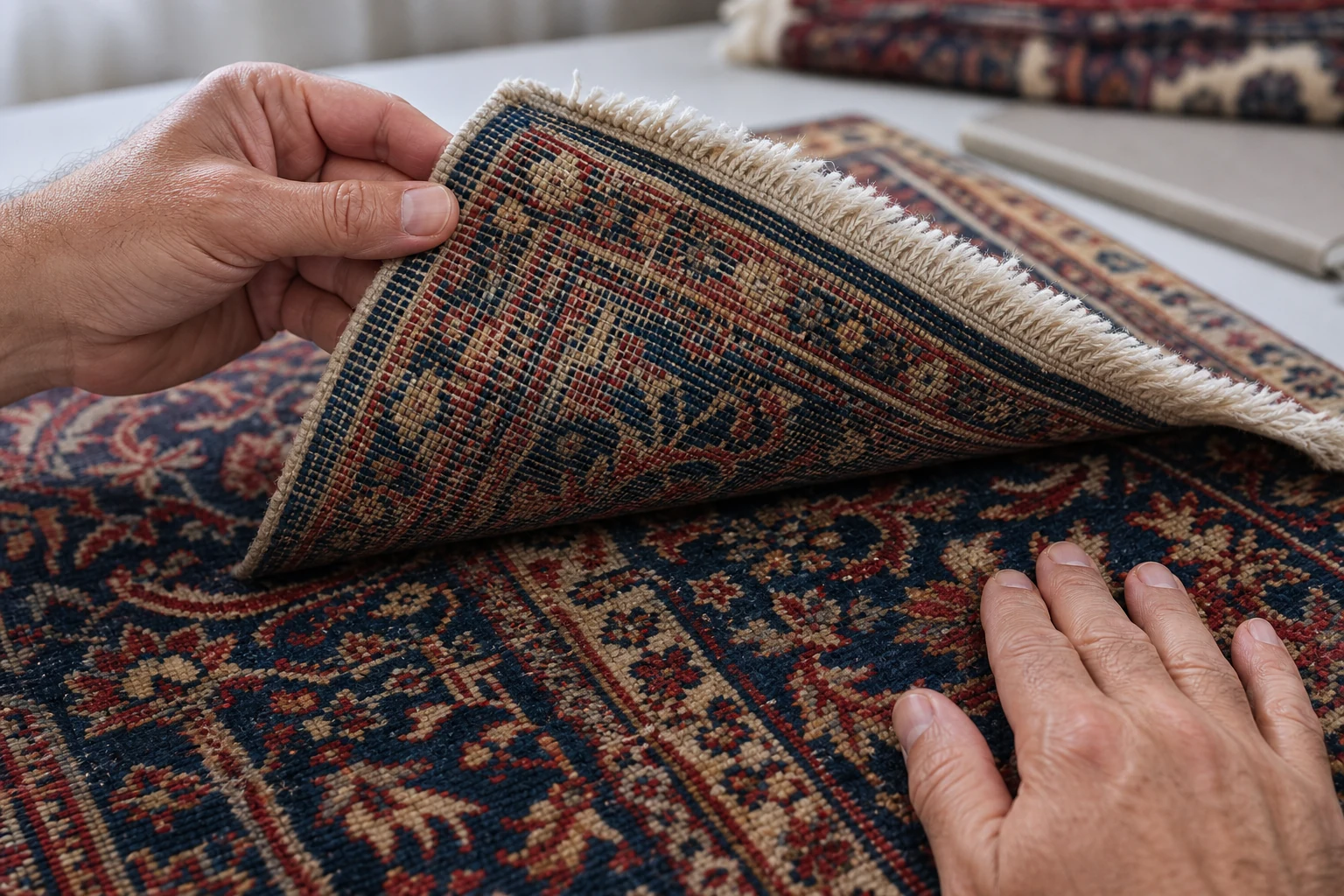
The reverse reveals the actual construction, fineness and some repairs that may not be apparent from the face.
4. Origin, workshop and quality of execution
A Persian rug is a rug made in Iran. Regional and city names refer not only to a pattern but also to traditions of structure, materials and drawing. A famous name does not automatically guarantee value: every region produces more than one quality level, and the individual rug must be assessed on its own merits.
For newer rugs, a particular workshop or recognised master may matter. For older pieces, documented provenance, original condition and consistency with the stated age and origin become more important. A reputable seller should distinguish between a documented fact and an expert attribution.
5. Age and condition: older does not automatically mean more expensive
Age alone does not guarantee value. An older rug can be desirable because of its rarity, quality and preservation, but it may also require costly repair. Check pile wear, exposed foundation, edges and fringes, stains, insect damage, distortion and earlier work visible on the reverse.
Good professional restoration does not necessarily destroy value, but it should be disclosed and reflected in the price. Crude reweaving, adhesive on the back or a poorly matched colour can be serious drawbacks. For a more expensive rug, have the condition and known repairs recorded in writing.
6. Colours, design and rarity
Traditional natural dyes, a harmonious palette and skilful colour handling can contribute to desirability and value. Gentle tonal changes from separate dye batches, known as abrash, may be a natural feature of handwork. This is different from severe sun fading, dye bleeding or a sharp colour break caused by a repair.
Demand for a design, rarity of format and the balance of the drawing also affect price. Personal taste remains more important than a fashionable label: a rug bought for a home must first work in that particular space.
What to verify before comparing prices
- Exact dimensions: not only a rounded size category.
- Country and region of origin: a “Persian design” is not the same as a rug made in Iran.
- Materials in each part: pile, warp and weft.
- Technique: hand-knotted, hand-tufted, flat-woven or machine-made.
- Condition and repairs: particularly for an older or more expensive piece.
- The stated price: whether it includes VAT, delivery and any additional services.
- Return terms: the ability to see the rug in your own light and room has real value.
How to buy well within a budget
Begin with the correct dimensions and intended use. In a busy living room, a good wool rug may be a better choice than a finer and more expensive silk piece. Then compare several rugs within the same size and material category. A discount or knot count alone should never be the sole reason to buy.
At Carpeteria, individual rugs can be opened out, inspected from both sides and compared at their true scale. Current prices are shown for each piece in the Persian rug collection. Delivery within the Czech Republic is free and you have 30 days to exchange or return your purchase, allowing you to assess the final choice in your own interior.