
Advice and inspiration
Is it normal for a hand-knotted rug to shed fibres?

Yes, a small quantity of short loose fibre can be normal on a new wool rug. Final clipping and finishing may leave tiny ends in the pile that work free during the first weeks of use. The amount should gradually diminish, however, and the rug's surface must not become visibly thinner.
A handful of fibre in a vacuum container does not by itself prove a fault. The trend, length of the loose material, location and condition of the pile matter more. Short fine fluff distributed across a new rug means something different from complete lengths of yarn, powder from the reverse or a bald patch in one area.
What does “shedding” actually describe?
Everyday language uses one word for several different conditions. Before vacuuming more aggressively or making a claim, look closely at what is coming away:
- Initial fluffing: a small quantity of short soft fibre lies on the surface or enters the vacuum. The pile remains continuous and the amount gradually falls.
- A protruding yarn or “sprout”: one longer end rises above the surrounding pile. This is not the same as general fluffing and should never be pulled.
- Pile breakage: brittle coloured fragments come away and a particular zone loses height or sheen. Wear, light, unsuitable cleaning or weakened material may be responsible.
- Insect damage: fibre loss may be accompanied by holes, grazed areas, webbing, larval cases or frass.
- Back deterioration: sand-like or rubbery powder beneath a rug may come from adhesive and latex in a hand-tufted rug, not from the knots of a genuine hand-knotted piece.
Why a new wool rug can fluff at first
The pile of a hand-knotted rug is clipped and finished after weaving. Short loose fibre may remain on the surface, while the yarn itself contains wool staple of differing lengths. Ordinary use and gentle vacuuming gradually remove those free fragments.
The intensity depends on wool grade and fibre length, spinning, yarn twist, pile height and finishing. A soft high pile made from more loosely spun yarn may produce more fluff than a low, firmly clipped pile. It is therefore impossible to prescribe an exact number of vacuuming sessions after which every rug must stop shedding.
What matters is an improving pattern. If the rug produces the same or more material each time, its design is changing or the foundation is becoming exposed, this is no longer simply a new product settling.
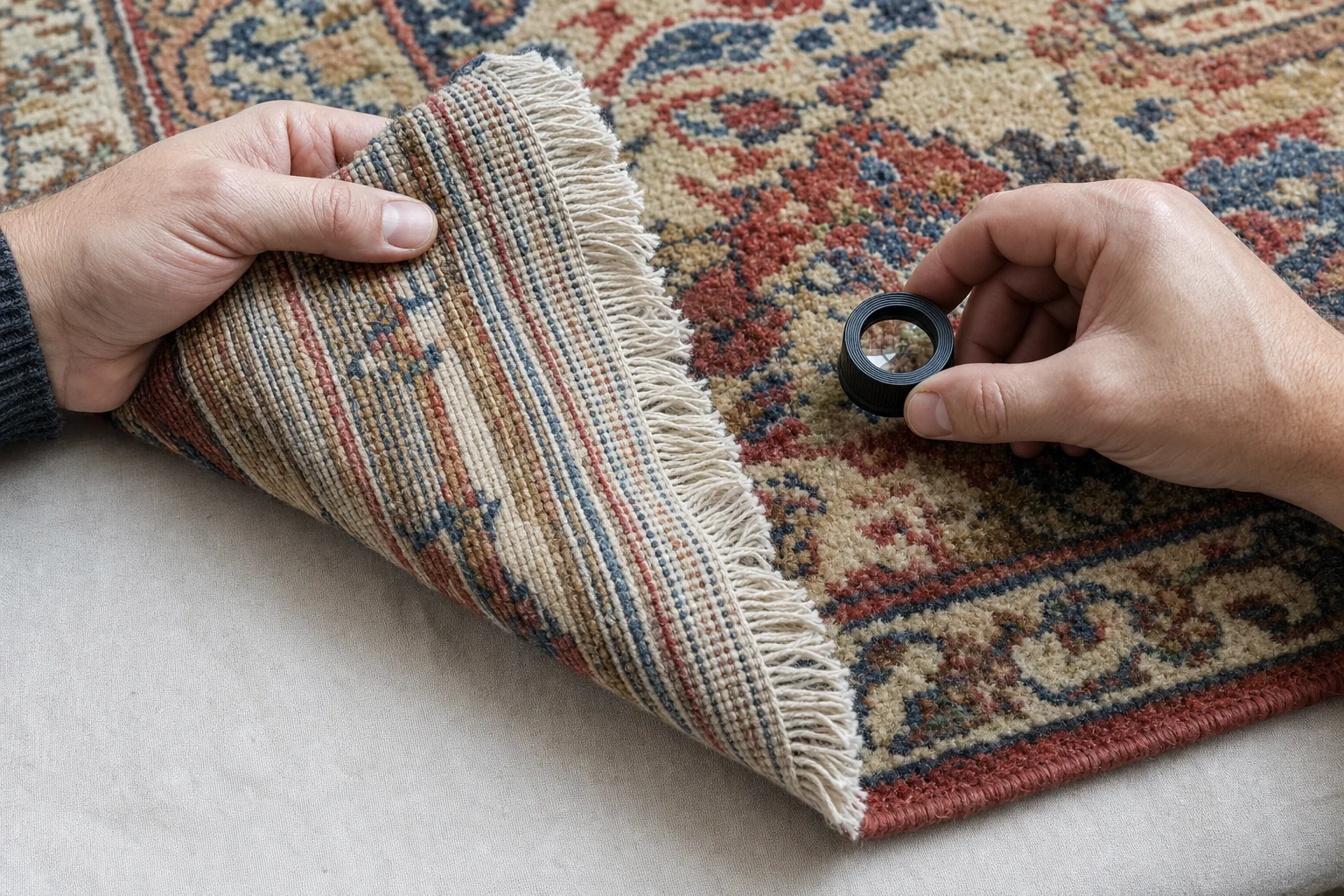
Assessment combines several clues: pile condition, length of loose fibres, reverse construction, edges and how the problem changes over time.
Hand-knotted is not the same as hand-tufted
The words “handmade” can conceal two entirely different structures. In a hand-knotted rug, each pile knot is tied around warp threads, and the drawing and rows of knots are normally legible on the reverse. Fringe usually continues from the warp, and the rug does not need a continuous adhesive layer to hold its pile.
In a hand-tufted rug, yarn is punched through a primary backing. Latex adhesive is spread over the reverse and often covered by a second textile. Such a rug may be decorative and well made, but its service life and ageing behaviour differ. Loose tufts, odour, a sticky reverse or sandy powder can be associated with deteriorating adhesive.
If a rug was sold as hand-knotted but its entire reverse is covered by cloth and no knot pattern is visible, do not address long-term shedding merely by increasing vacuum power. Have the construction and written description checked first.
How to vacuum without making the problem worse
Dust and grit inside a rug act as an abrasive under foot, so abandoning cleaning altogether is not the answer. An aggressive method can, however, damage weak pile or loose ends.
- Before vacuuming, inspect for loose threads, sides and fringe.
- Disable the revolving brush or powered roller and use a smooth nozzle.
- Choose low effective suction and move slowly in the pile direction.
- Do not press the nozzle into the surface or pass repeatedly over one spot.
- Do not vacuum fringe at full power or allow it to enter the machine.
- On a fragile or historic rug, use a clean protective screen after professional advice, or omit vacuuming.
A robotic vacuum may repeatedly cross one route and catch fringe or a protruding thread. Do not let it work unattended over a fine hand-knotted rug until you have verified safe clearance, and exclude vulnerable zones.
Never pull a protruding thread
One longer end above the pile may be harmless residual yarn, but it can also relate to a knot, repair or structural element. Pulling can loosen a larger area. Photograph the thread, see whether it is growing longer and show it to a specialist if the rug is valuable or old.
On an ordinary new rug, a demonstrably loose end can be levelled with sharp scissors exactly to the surrounding pile after advice; do not cut blindly near the reverse or apply glue. If you do not know what the thread secures, leaving it without tension until examination is the safer option.
When fibre loss is no longer normal
- the amount does not decline after weeks of normal use but increases,
- long yarns or complete tufts come away rather than short fluff,
- the surface is locally thinner, harder, differently lustrous or exposes the foundation,
- the problem concentrates at a doorway, beneath castors, in sunlight or after cleaning,
- larvae, cases, webbing, frass or tiny holes appear on the reverse or in dark areas,
- new powder, odour or sticky material accumulates beneath the rug,
- fringe, side binding or a repaired area begins to disintegrate.
Stop vacuuming the affected zone when any of these signs appears. Do not tape the rug, spray it with insecticide or attempt to secure the pile with varnish or an “anti-shedding” product. Unsuitable chemicals can soil fibres, alter colour and complicate repair.
How to monitor change without a home “pull test”
Do not tug the pile repeatedly to test its strength; that creates additional mechanical stress. Instead, photograph the same area once a week from the same position and in the same light. Include a fixed reference such as the corner of a motif.
After gentle vacuuming, observe the volume and type of material in a clear container. If it matters for a claim or assessment, keep a small sample in a clean sealed bag and note the date and location. Distinguish short soft fluff, long yarn, hard coloured powder and material coming from the reverse.
Check the underlay and floor too. Debris can come from underlay, old adhesive, gaps in a timber floor or another textile in the room. Material found beneath the rug does not automatically mean its pile is disintegrating.
Insects cause local rather than even pile loss
Clothes moth and carpet beetle larvae consume keratin fibres including wool. They often favour dark, quiet and soiled positions beneath furniture, beside a wall or on the reverse. Local grazing, holes and signs of insect development are more characteristic than uniform fine fluff across the whole surface.
Separate a suspect rug from other wool textiles and request identification without unnecessary shaking. Inspect nearby upholstery, wool clothing, skirting and dust in undisturbed corners. Removing one adult moth does not address larvae hidden in material.
What limits genuine wear
- use an appropriate underlay to reduce movement and cushion pressure,
- lift furniture rather than dragging it and place broad smooth cups beneath heavy feet,
- limit outdoor shoes and trap grit with an entrance mat away from the valuable rug,
- rotate the rug periodically to distribute traffic and light more evenly,
- control fierce direct sun with curtains or blinds,
- blot spills without rubbing and entrust complete cleaning to a hand-knotted rug specialist.
Wool quality and structure are fundamental, but placement controls how quickly pile wears mechanically. Even an exceptional rug is not indestructible beneath a castor chair, in a wet entrance or in a narrow route used by everyone in the household.
A quick diagnostic table
| What you observe | Likely explanation | Safe first action |
|---|---|---|
| A little short soft fluff across a new rug | Loose surface fibre from manufacture and clipping | Vacuum gently and check that the amount declines |
| One long protruding end | Residual yarn, a knot or structural thread | Do not pull; photograph and identify before trimming |
| A thinning area with brittle coloured fragments | Pile breakage or severe mechanical wear | Stop traffic and arrange an inspection |
| Holes, grazing, cases or webbing | Possible insect activity | Separate from other textiles and contact a specialist |
| Sand, odour or sticky dust from a covered reverse | Possible latex deterioration in a hand-tufted rug | Verify the construction and avoid aggressive vacuuming |
When to contact the seller or a specialist
For a new rug, prepare photographs of the face and reverse, the purchase date, vacuuming method and several images showing the change. The seller should explain the materials, construction and expected initial behaviour of that particular product. Assessment should focus on the actual surface condition, not just one full vacuum container.
Do not delay specialist inspection if the rug is old, collectible, water-damaged, recently cleaned by an unsuitable method or shows signs of insects. A small timely repair to a side or pile is usually much simpler than reconstructing an extensive loss.
Some initial fluff can therefore be normal, but “normal” does not mean unlimited. Watch whether the quantity diminishes and the pile stays continuous. At the Carpeteria showroom in Prague 5, we will gladly show you the difference between loose wool fluff, a protruding yarn, genuine wear and another construction by examining the reverse of an actual rug.