
Advice and inspiration
Should you use a rug pad under a hand-knotted rug?

In most interiors, a good rug pad is a sensible addition beneath a hand-knotted rug. It helps keep the rug in place, reduces rippling and movement, improves comfort underfoot and creates a separating layer between the rug’s reverse and the floor. That does not mean every inexpensive mesh or foam pad is suitable.
The pad must be chosen for the specific rug-and-floor combination. A material that performs well on stone or sealed parquet may discolour vinyl or bond to its surface over time. A pad that is too soft can also make furniture less stable and raise the rug unnecessarily.
Short answer: yes, when the pad is right
For an ordinary wool hand-knotted rug on a smooth hard floor, a thin, dense and dimensionally stable pad is usually the practical choice. If grip is the main requirement, use a low-profile non-slip material approved for that floor finish. If you also want more cushioning, a dense felt pad with a non-slip layer may be appropriate.
A pad should support the rug, not turn it into a soft mattress. For a fine, old, silk or restored piece, look for a smooth surface without hard projections, adhesive or aggressive plasticisers. It is sensible to test the chosen product in an inconspicuous part of the floor first and to follow the flooring manufacturer’s instructions.
What a good rug pad actually does
- Limits slipping and movement. The rug remains more stable during walking, vacuuming and ordinary furniture movement.
- Reduces mechanical stress. A firm resilient layer partly cushions foot pressure between the textile and a hard floor.
- Protects the floor. It separates a coarse rug reverse from a sensitive finish and reduces direct abrasion.
- Adds comfort and absorbs sound. The rug can feel fuller and footsteps become quieter.
- Helps the rug hold its shape. A correctly placed rug is less likely to bunch and its edges move less.
A pad cannot stop sharp grit, trapped moisture or stains on its own. Nor will it repair weakened fringe, poor restoration or unstable dyes. The rug and the space beneath it still need regular vacuuming, inspection and dry conditions.
Choosing a pad for the floor beneath
| Floor beneath | What to look for | What to avoid |
|---|---|---|
| Wood flooring and parquet | Thin dense felt, quality natural rubber or a combination approved for the finish | Cheap PVC mesh, sticky residue, trapped moisture and reactions with lacquer or oil |
| Stone and ceramic tile | A stable non-slip pad; firm felt with grip if extra comfort is wanted | Excess thickness, uneven grout lines and raised rug corners |
| Vinyl, LVT and resilient flooring | Only a non-staining pad explicitly approved by the floor manufacturer | Unverified rubber, latex and some PVC products can react with the surface and permanently discolour it |
| Laminate | A low stable pad compatible with the wear layer and any heating system | Moisture, very soft foam and unnecessary obstruction of heat |
| Fitted carpet | A specialist rug-on-carpet pad | A normal hard-floor gripper may not work and the upper rug can ripple |
| Underfloor heating | Low thermal resistance and explicit approval for heated floors | The combined resistance of floor, pad and rug, overheating and an unsuitable non-breathable layer |
Felt, natural rubber, combination or mesh?
Dense felt cushions pressure and sound well, but may not provide enough grip by itself on a smooth floor. It works where furniture already helps stabilise the rug or as part of a combination pad. It should be firm and dimensionally stable rather than excessively soft.
Natural rubber offers good grip at a low thickness. On a wooden floor, a quality non-staining product can be suitable, but always check compatibility with the lacquer or oil finish. Do not automatically use rubber or latex on vinyl and other resilient flooring: some floor manufacturers explicitly warn that these materials can cause chemical discolouration.
A felt-and-grip combination balances stability with moderate cushioning and often works well beneath larger area rugs. Cheap open plastic meshes, by contrast, may become brittle, imprint the surface or leave a sticky residue. Price is not the only test, but the product should clearly identify its material, intended use and compatible floor types.
Correct thickness and size
A lower, firmer pad is normally better beneath a hand-knotted rug than a very thick foam. The rug must remain stable, doors need to clear it safely and furniture legs should not stand on a soft raised edge. For a thin rug or a piece with a fine foundation, choose an especially smooth, dense pad without pronounced texture.
The pad should be slightly smaller than the rug on every side – in practice, roughly 2 to 3 centimetres inside the edge, adjusted for the rug’s thickness and shape. It should not protrude and normally does not sit beneath the fringe. If the pad needs trimming, cut it straight without leaving frayed or hard edges.
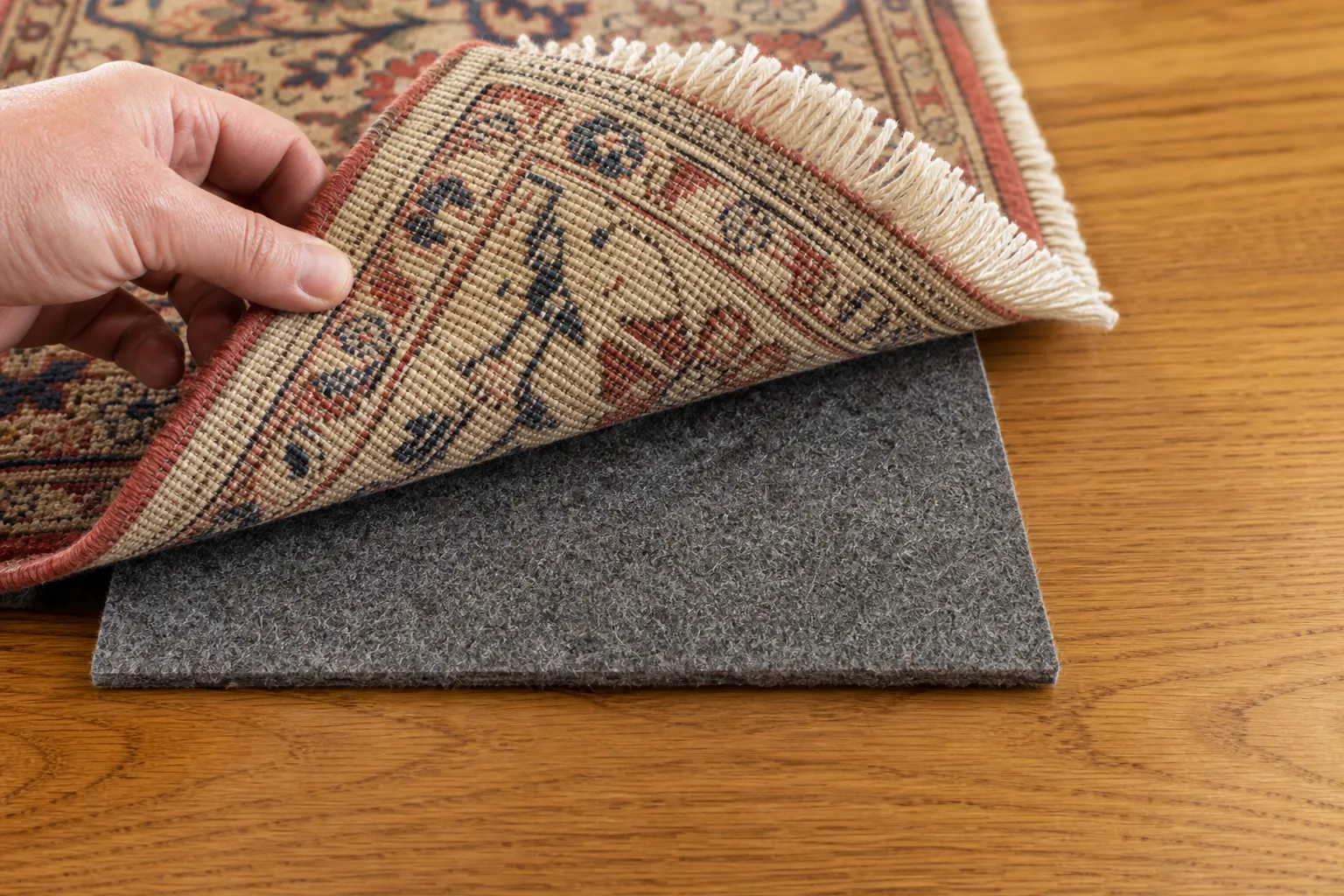
The pad should form one continuous low-profile layer. Its edge remains a few centimetres inside the rug and is invisible once the rug is flat.
How to place the pad correctly
- Vacuum the floor and clean it as directed by its manufacturer. Let it dry completely.
- Inspect the rug’s reverse, remove loose grit and examine the fringe and side edges.
- Lay the pad flat without folds or overlapping sections.
- Place the rug from one side and unroll it gradually. Do not pull it by the fringe.
- Smooth any ripples by hand from the centre towards the edges and check that the pad does not protrude.
- Before returning heavy furniture, confirm that the rug is stable and doors move freely.
Do not attach the pad to the rug or floor with ordinary double-sided tape. Adhesive can migrate into fibres or the floor finish, and later removal can damage both materials. If a special installation genuinely needs fixing, it should be selected by a professional for that exact floor and textile.
Maintaining the pad and the area beneath
Several times a year, lift the rug and check that the pad is dry, clean, resilient and not bonding to the floor. Vacuum the floor, both sides of the pad as its construction allows, and the rug reverse with appropriate care. After wet cleaning, reassemble the layers only when everything is completely dry.
Watch for a change in floor colour, crumbling pad material, odour, mesh imprints or sticky marks. Remove the pad immediately if any of these appear. Do not repair a damaged, rippled or hardened pad by laying another sheet over it; replace it as one complete layer.
When the choice needs individual assessment
A very small rug may remain a trip hazard even with a pad. On an antique, silk, exceptionally fine or restored piece, an unsuitable texture can press into a weakened foundation. On newly lacquered or oiled flooring, you must wait until the finish has fully cured according to the manufacturer’s instructions.
If you are unsure about the floor finish or the rug’s construction, bring photographs of the room, floor and both sides of the rug to the Carpeteria showroom in Prague 5. We can help choose the pad type, thickness and dimensions so the rug lies securely while the floor remains protected.