
Advice and inspiration
How should you care for a hand-knotted rug with silk?

A hand-knotted rug containing genuine silk needs more careful treatment than an ordinary hard-wearing wool rug. Silk permits exceptionally fine drawing and changes its lustre with the direction of the pile, but prolonged light, harsh rubbing, furniture castors and unsuitable wet cleaning can cause damage that cannot be completely reversed.
The essential rule is simple: prevent soiling, remove only loose dust by a gentle method and do not attack stains with an aggressive home recipe. The more valuable, finely woven or historic the rug, the more important it is to assess its materials, colourfastness and structural condition before treatment.
First establish exactly where the silk is
A “rug with silk” may have an entirely silk pile, silk outlines within wool pile, or a silk foundation beneath another fibre. Care should follow the most vulnerable component. If the composition is uncertain, check the paperwork and ask a specialist to examine the face, reverse and fringe.
Lustre alone does not prove genuine silk. Viscose, rayon and other regenerated cellulose fibres can look similar and have their own cleaning requirements. Trade terms such as “art silk” and “bamboo silk” are not adequate technical descriptions. Before professional cleaning, the cleaner needs the actual fibre identity, not merely a marketing name.
Choose a quiet position away from direct sun
Light damage is cumulative and irreversible: dyes fade and fibres gradually lose strength. Do not place a silk rug in a band of fierce sunlight in front of a large window. Curtains, blinds or UV management help, but even diffuse daylight and artificial light are not entirely neutral to textile ageing.
Rotate the rug periodically when its condition and the room layout allow. This distributes normal wear and exposure more evenly. Rotation is not a substitute for controlling light, however; a faded half cannot be restored to its original shade.
Avoid a damp basement, unventilated conservatory, immediate proximity to a radiator and locations with abrupt changes in temperature or humidity. A stable, clean, normally inhabited environment is safer than a room that alternates between very dry and humid conditions.
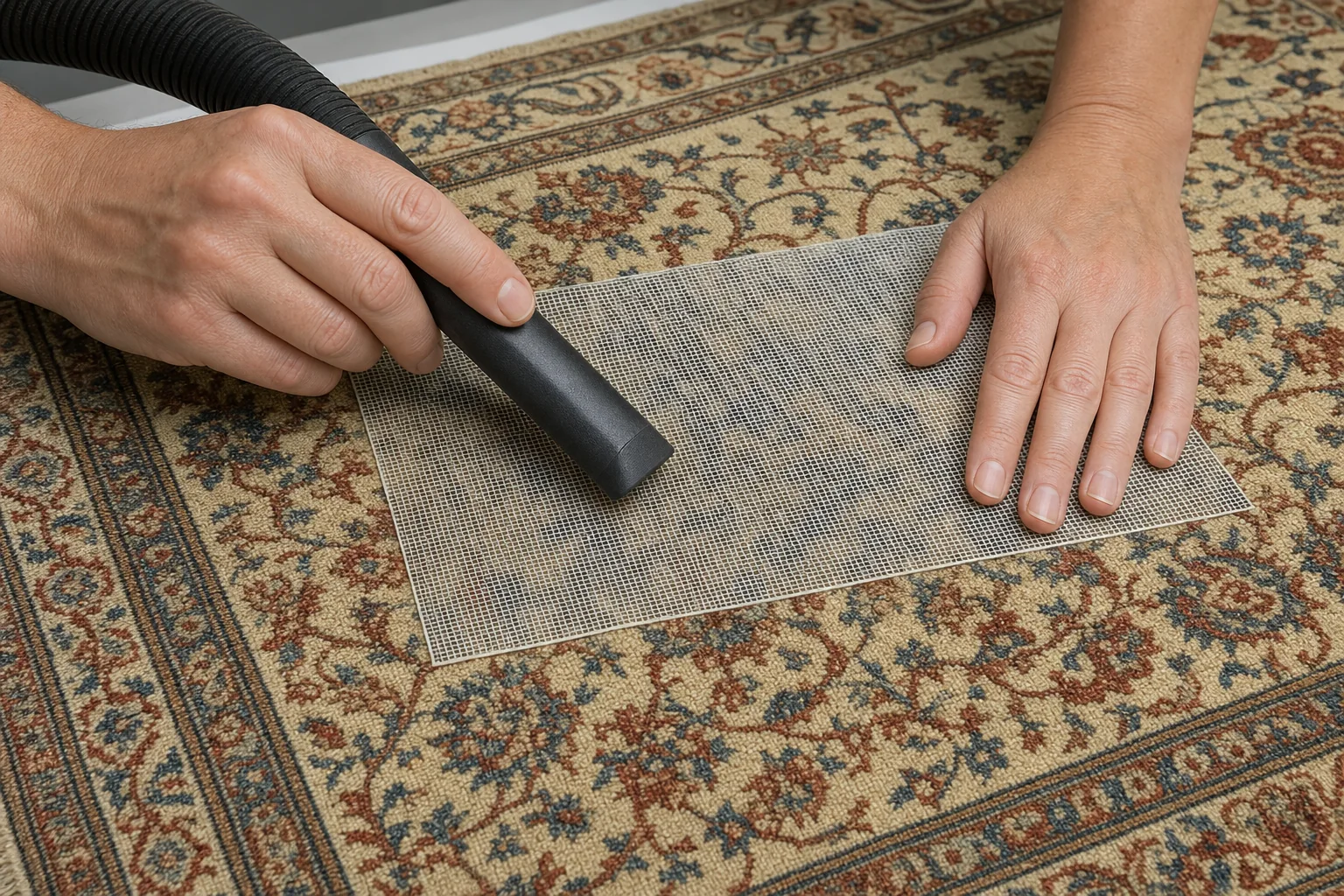
On a fine or weakened surface, a clean screen keeps fibres in place while low suction removes loose dust only.
How to vacuum a silk rug safely
Dust is more than a cosmetic issue. Hard particles settle between fibres and act as a fine abrasive under foot. Regular but very gentle surface maintenance is therefore safer than long neglect followed by aggressive cleaning.
- Inspect before you begin. If pile is powdering, splitting, lifting at the edges or releasing knots, do not vacuum; have its condition assessed.
- Disable the revolving brush. Use a smooth nozzle without a powered roller and the lowest effective suction.
- Work in the pile direction. Move slowly without pressure or repeated rubbing over one spot.
- Protect a fragile surface with a screen. Place clean smooth mesh over one small section and work above it; test the method in an inconspicuous area first.
- Leave the fringe alone. Do not vacuum it at full power or allow it to enter the nozzle.
There is no universal timetable. Frequency depends on dust, traffic and condition. A little-used room may require inspection and gentle vacuuming only at wider intervals. A busy area needs more frequent care, but may not be a suitable location for a fine silk rug at all.
What to do when liquid is spilled
Act promptly but without panic. Lift solid material gently with a spoon rather than spreading it. Blot liquid from above with a clean white absorbent cloth; do not rub, brush or force the spill deeper into the pile. A second clean absorbent layer can be placed beneath the wet area if the rug can be lifted without stretching it.
Do not automatically apply water, vinegar, baking soda, salt, washing-up liquid, stain remover or ordinary carpet shampoo. An uncertain dye may migrate, silk lustre can change and detergent residue may attract more soil. Hot air and vigorous friction can make the problem worse as well.
After basic blotting, contact a specialist in hand-knotted silk rugs and explain what was spilled, when it happened and what has already been applied. Photograph the area in natural light. With a coloured, oily, acidic or sugary liquid, do not wait for the stain to dry.
Why home wet cleaning is risky
A machine designed for ordinary fitted carpet cannot automatically evaluate dye fastness, foundation structure or old repairs. Excess moisture can move dark colour into pale areas, distort the foundation, create tide marks and leave the rug damp for too long. Mechanical brushes can also alter a fine surface and draw out weakened fibres.
Professional cleaning does not merely mean a more powerful machine. An experienced specialist identifies the fibres, examines the reverse and damage, tests colours and chooses the method, moisture level, support and drying process for that particular object. Ask specifically about experience with genuine silk and hand-knotted rugs, not only with routine carpets.
Furniture, foot traffic and an appropriate underlay
A fine silk rug does not belong beneath an office chair on castors or where dining chairs move back and forth several times a day. Repeated pressure and shear stress both pile and foundation. Lift heavy furniture rather than dragging it, and use broad smooth castor cups to distribute the load under its feet.
A good underlay reduces movement and cushions small floor irregularities. It must suit both the flooring and the rug, lie just inside the rug's outline, remain clean and contain no adhesive that may age or leave a residue. Inspect the underlay, floor and reverse periodically.
A simple no-outdoor-shoes rule and keeping food and drinks away from the rug prevent many accidents. Keep pets' claws trimmed and watch for snagging in the fine weave. With silk, prevention is considerably safer than later repair.
Protect the fringe and sides
Fringe normally continues from the warp; it is not disposable decoration. Do not force it straight with a comb, bleach it or repair it with glue. If an end is opening or a securing knot has disappeared, specialist repair should take place before the loss advances into the pile field.
Do not fold an edge beneath the rug or tape it to the floor. A curling corner first needs a diagnosis: the cause may be an unsuitable underlay, structural distortion or an earlier treatment. Improvised adhesive makes future conservation harder.
Routine inspection catches damage early
When rotating the rug, examine its face, reverse, sides and the areas beneath furniture. Look for new loose threads, tiny holes, webbing, larval cases, powder, damp marks or altered sheen. Clothes moth and carpet beetle larvae may damage soiled protein fibres; a clean room, vacuumed floor cracks and inspection of dark undisturbed areas are important.
Do not cut or pull a loose thread unless you know what it secures. Photograph the spot, note its position and compare it at the next inspection. If the change is growing, take the rug out of use and request an assessment.
Moving and storing the rug
Do not lift a large rug by one edge or its fringe. It needs even support and usually two people. For longer storage, ensure it is clean and completely dry and never fold it into sharp creases. Roll it without crushing around a wide rigid tube protected by an appropriate archival interlayer, then cover it with clean breathable fabric.
Support the roll evenly or by the tube ends so the rug remains off the floor. An attic, basement and position beside heating or plumbing are unsuitable. Inspect a stored rug periodically for moisture and pests; a sealed covering around a rug that is not entirely dry can create a hazardous microclimate.
When to call a specialist immediately
- the rug is saturated or has been standing in water,
- colour transfers to a white cloth or forms tide marks,
- there is mould, a musty smell or unexplained powder,
- pile is breaking, powdering or disappearing down to the foundation,
- fringe or side loss is advancing into the field,
- the piece is old, collectible or financially significant and has no documented cleaning history.
Do not fold a saturated rug, walk over it or dry it with hot air. If it is safe for both you and the building, stop the water source, ventilate the surrounding area and call a specialist promptly. A large wet rug becomes extremely heavy and its structure can tear if it is lifted incorrectly.
A concise safe-care plan
| Situation | Safe first action | Avoid |
|---|---|---|
| Routine dust | Low suction, smooth nozzle, pile direction; screen a fragile piece | Revolving brush, pressure and vacuuming fringe |
| Liquid spill | Blot at once with clean white cloth and contact a specialist | Rubbing, household chemicals, heat and saturation |
| Direct sun | Control the light and relocate safely | Relying only on occasional rotation |
| Loose thread | Reduce traffic, photograph and arrange assessment | Pulling, cutting or gluing |
| Long storage | Roll the clean, dry rug on a wide protected tube | Folding, damp basements and unchecked sealed wrapping |
Good care for a silk rug is not a complicated collection of home tricks. It is sensible placement, gentle dust removal, prompt blotting without rubbing and timely help from someone who understands hand-knotted structure. At the Carpeteria showroom in Prague 5, we can help establish the material of a particular rug, assess its proposed placement and recommend a safe next step.