
Advice and inspiration
How to choose a quality hand-knotted rug for your home

A quality hand-knotted rug cannot be selected from one number or the word “silk”. High knot density allows finer drawing, but does not by itself guarantee good wool, secure edges, stable colour or balanced construction. Natural fibre may be excellent or mediocre, and an exceptionally fine rug may not be the best choice for a busy family room.
For a home, assess three things together: what the rug truly is, how well it is made and its present condition, and whether it suits the place where you intend to use it. Their combination determines whether the individual piece is a quality choice for you.
Three layers of real quality
| Layer | What to verify | Why it matters |
|---|---|---|
| Identity and construction | Technique, origin, pile, warp and weft materials | The marketing description must agree with how and where the rug was made |
| Execution and condition | Knots, tension, pile, sides, ends, colour, repairs and damage | These determine stability, appearance and future care costs |
| Suitability for home | Dimensions, traffic, light, furniture, children, pets and maintenance | Even an excellent rug can be wrong for the room in which it is placed |
1. First confirm that it is genuinely hand-knotted
Lift a corner on a clean surface. On a hand-knotted pile rug, the design remains legible on the reverse and close inspection reveals individual knot nodes with warp and weft passing through the structure. The back is not normally concealed by a continuous layer of adhesive or a rigid second textile. Fringe often continues from the warp threads on which the rug was built.
There are exceptions: an older rug may have a conservation lining, professionally replaced fringe or a repaired end. Do not rely on one sign. Inspect the reverse and edge together with the documentation, and ask whether the piece is hand-knotted, hand-tufted, flat-woven or machine-made.
A hand-tufted rug may be attractive, but its yarn is inserted into a prepared cloth and commonly secured with adhesive on the reverse. “Handmade” therefore does not by itself confirm hand-knotting.
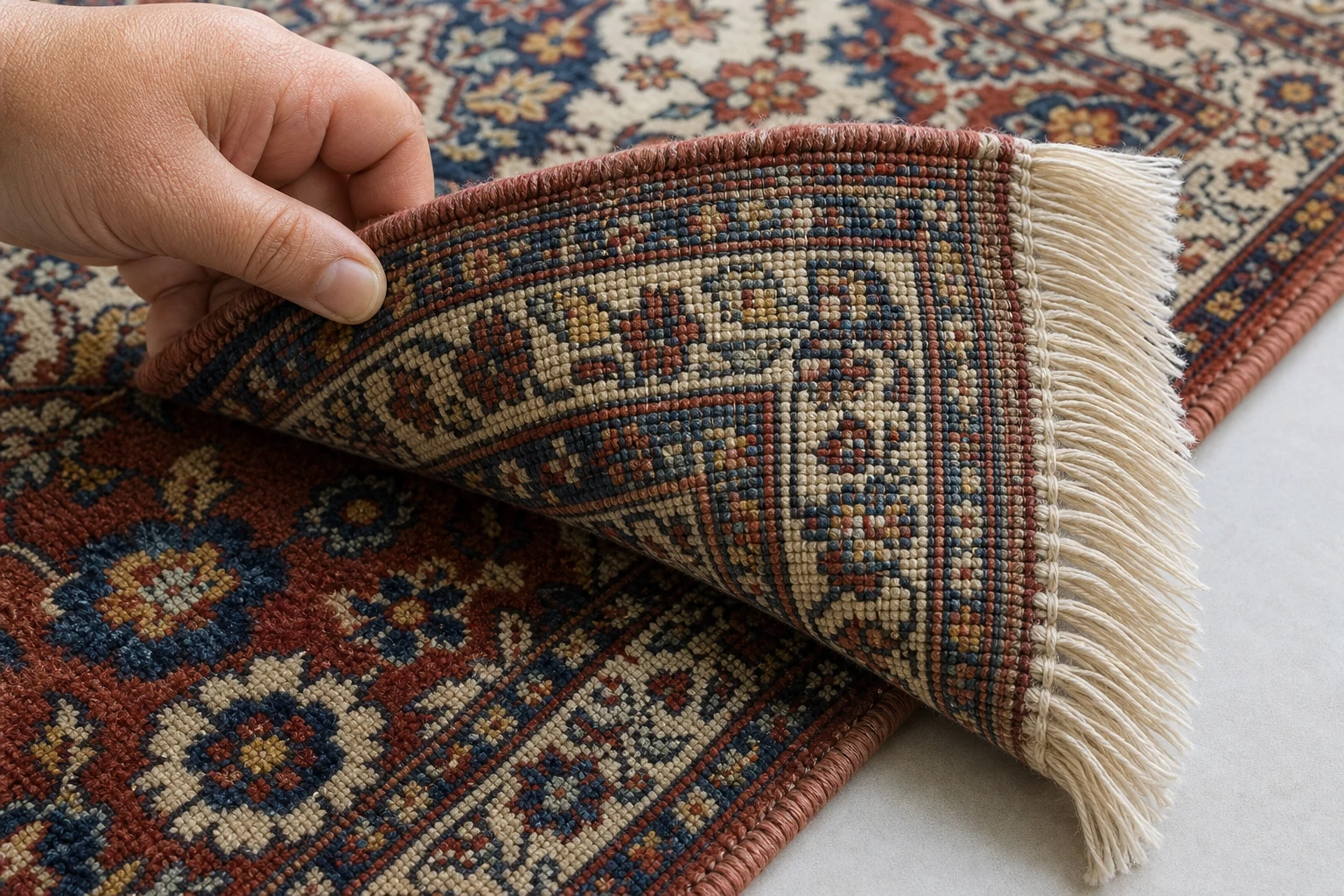
Face, reverse, side and fringe belong to one construction. Examine how they relate rather than looking for an isolated marketing clue.
2. Judge materials by grade and intended use
Wool is the most common pile fibre in good functional rugs. Suitable carpet wool feels resilient, has a natural rather than plastic sheen and recovers when the pile is brushed. Fibre length and strength, cleanliness of processing, yarn twist and suitability for the construction matter more than a generic “100% wool” line.
Silk permits very fine drawing and changes its reflection with pile direction. It is costly and more sensitive to abrasion, moisture and unsuitable cleaning. An all-silk rug is not automatically better than a first-rate wool piece; it serves a different purpose and generally needs a calmer environment.
Cotton commonly forms the warp and weft of city rugs because it supports a regular, dimensionally stable foundation. Village and nomadic rugs may use wool foundations. Ask separately about pile, warp and weft, because they need not contain the same fibre.
High lustre does not necessarily mean natural silk. It may be viscose or another regenerated cellulose fibre. Have the exact composition recorded in writing and do not use flame, chemicals or pulled fibres as home tests.
3. Knot density is a tool, not a score out of ten
More knots in the same area allow smaller curves, contours and details. The figure is most useful when comparing rugs of similar origin, material and type. A robust village rug made from strong hand-spun wool naturally uses thicker yarn and fewer knots than a fine floral city rug.
The number alone cannot tell you whether the wool is resilient, knots secure, tension even or edges properly finished. A very dense rug may use brittle fibre or have damaging surface treatment, while a less finely drawn piece may be beautifully balanced and well suited to decades of everyday use.
Ask which unit is being used: knots per square centimetre, square decimetre, square inch and regional measurements are not interchangeable. A reputable seller should be able to explain how the figure was calculated and why it suits the design.
4. Inspect the workmanship of the complete rug
- Pile: it should be reasonably evenly clipped, without unexplained bald areas, crumbling fibres or large variations outside an intentional relief.
- Sides: overcasting should be continuous and secure, with no fresh adhesive or exposed loose warps.
- Ends and fringe: fringe is not the main quality measure, but the ends must be secured so the structure does not begin to unravel.
- Shape: the rug should rest calmly on a level floor. Small variations belong to handwork; pronounced waves, bulges or severe skew need an explanation.
- Drawing: lines and proportions should feel intentional. A small motif variation may be a human signature; a sudden break can indicate a fault or repair.
View the rug from several metres away and then close up. Distance reveals compositional balance and shape; detail reveals pile, knots and finishing. Neither view can replace the other.
5. Distinguish natural colour variation from damage
Hand-dyed yarn from separate dye batches can create gentle horizontal shifts known as abrash. In a traditional rug these may be natural and appreciated. They differ from a sharp patch of sun fading, a mismatched repair or evidence that dye has migrated.
Colours should work as a system: field, border and accents should not compete without an artistic reason. “Natural dye” does not prove quality by itself, and synthetic dye does not automatically make a rug poor. Skilled dyeing, suitable stability and transparent description matter.
Do not test colourfastness at home with a wet cloth or cleaner in a hidden corner. Improvised wetting can cause the very damage you are trying to detect. Ask a specialist to assess colour when there is doubt.
6. On an older rug, condition may matter more than original fineness
Inspect the entire face and reverse, especially central walking routes, furniture areas, sides and ends. Look for exposed foundation, cracking structure, insect holes or grazing, loose knots, musty odour, stiff adhesive patches, water marks and abrupt changes in pile height.
An older professional repair is not automatically a problem. It may stabilise a rug and extend its life. Its extent should nevertheless be disclosed, the work should respect the original structure and the price should reflect the real condition. Fresh colouring, broad adhesive and decorative backing must not conceal damage.
For a more valuable rug, ask to have known repairs marked on a photograph or stated in the written description. “Perfect for its age” is not a substitute for specific condition information.
7. Quality for home also means the right durability
| Space | What commonly works | Watch for |
|---|---|---|
| Everyday living room | Resilient wool, sound construction, low-to-medium pile, suitable underlay | Direct sun, narrow furniture feet and very delicate fringe |
| Busy family area | Durable wool, forgiving all-over pattern, easily inspected edges | Very fine silk, high relief and weakened older pieces |
| Dining room | More even surface and a size supporting pulled-back chairs | Deep pile, catching edges and unstable underlay |
| Bedroom | Softer handle, comfort and a drawing appropriate to a calm room | A medallion hidden by the bed and an undersized format |
| Hall or entrance | Firm wool, lower pile, stable shape and non-slip underlay | Grit, damp, salt, door clearance and rapid one-sided wear |
| Quiet formal room | May accept a finer, silk or older rug | UV light, unsuitable cleaning and moving heavy furniture |
A rug should not be selected as an object isolated from household life. Children, pets and everyday use do not rule out a quality hand-knotted rug when material, construction, pattern and condition are chosen accordingly.
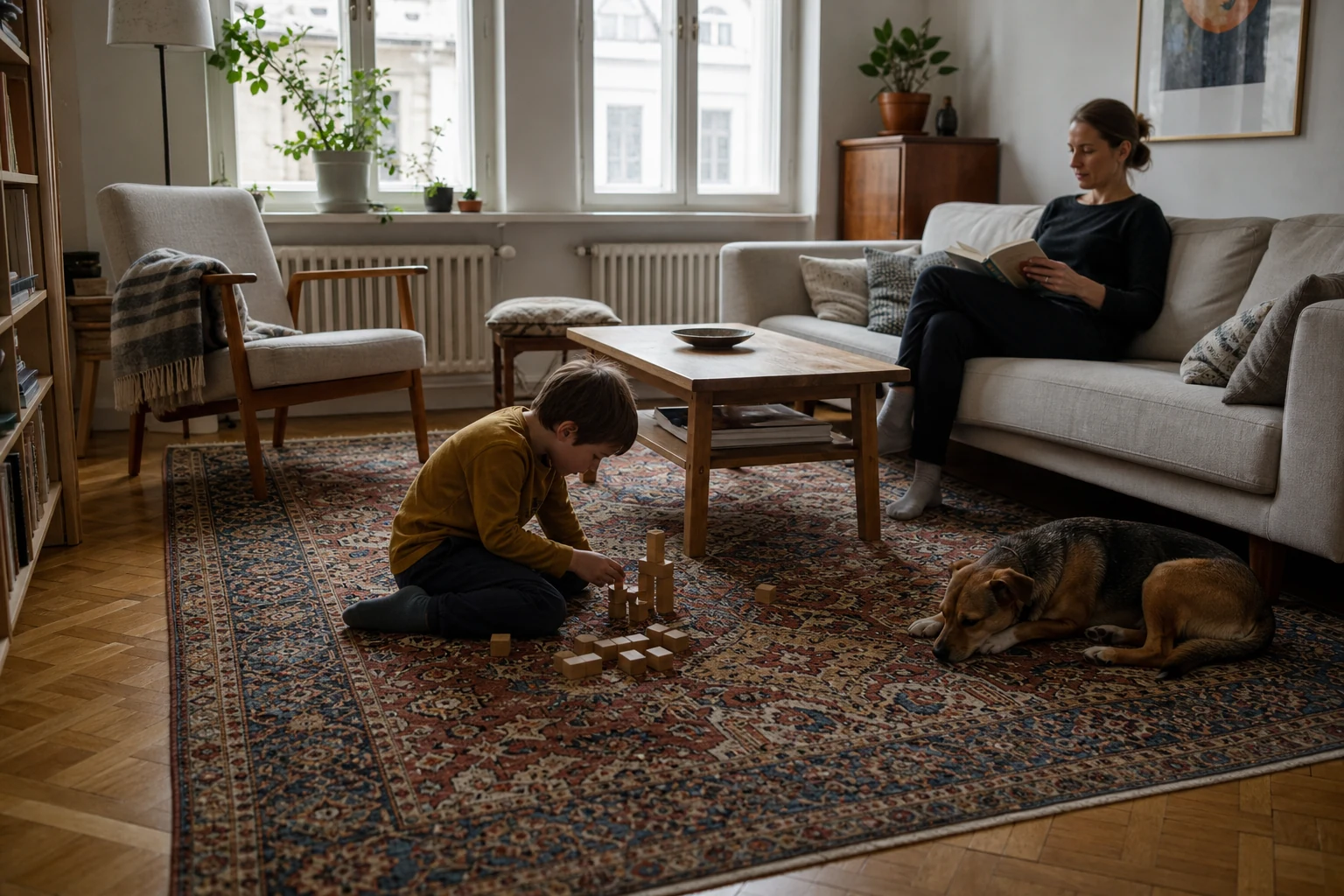
For a lively household, a quality wool rug may be a better choice than an exceptionally fine, delicate piece. Quality includes suitability for the way the rug will genuinely be used.
8. Assess new and older rugs differently
On a new rug, expect a precise description of origin, material and technique, stable finishing and no concealed intervention. Some short residual fibre may be released after finishing, but long yarn should not pull free and sides should not open.
On an older piece, lower pile, patina and professional repair may belong naturally to its history. Stability of the foundation and honest description are decisive. Older does not automatically mean rarer, and new does not mean less valuable; origin, materials, workmanship, design, condition and market all contribute.
9. Request information tied to the individual piece
An invoice or certificate is useful only when it identifies the rug in front of you. It should correspond to a photograph or stock number, exact dimensions, country and where appropriate region of origin, technique, pile and foundation materials, approximate age and known restoration.
“Persian” properly describes origin in Iran; a Persian design made elsewhere is not the same thing. A regional name such as Tabriz, Kashan or Heriz should not function merely as a pattern label without a defensible connection to origin. A reputable seller distinguishes documented fact from informed attribution.
Before buying, have the final price, tax, delivery, return or exchange terms, recommended underlay and relevant care requirements confirmed in writing. An oral story with no link to the individual rug is not documentation.
10. Compare total cost rather than the price tag alone
Include suitable underlay, any immediate professional repair, delivery, future specialist cleaning and likely service in the intended room. A cheaper older rug with failing ends may need urgent stabilisation; a more expensive but sound wool piece may be more economical for everyday use.
Price itself does not prove quality. It also reflects size, origin, age, material, fineness, design, dealer positioning, condition, rarity and current demand. Compare like with like and ask what evidence supports a price difference.
A fifteen-minute showroom check
- Have the rug opened out completely on a level surface.
- View shape and drawing from several metres away and from both pile directions.
- Lift a corner and inspect actual knots, reverse, side and how the fringe joins the structure.
- Brush the pile lightly by hand and observe resilience, direction and unexplained thin areas.
- Examine all four sides and both ends.
- Compare any suspicious area from face and reverse and ask about repair.
- Measure the exact dimensions and check them against the document.
- Request written origin, materials, technique, condition and purchase terms.
Warning signs
- the seller will not show the reverse or open the rug fully,
- “handmade” is used without naming the exact technique,
- quality is explained only by knot count or the word silk,
- attached fringe or deliberate irregularity is presented as the sole proof of hand-knotting,
- pile and foundation materials cannot be stated separately,
- origin is confused with the name of a pattern,
- the certificate does not identify the individual rug,
- known repair, stains or unstable edges are not disclosed,
- you are pressured to decide before a calm inspection.
The final decision: five questions
- Are technique and origin described precisely and supported?
- Do materials, density and workmanship make sense for this type of rug?
- Is the current condition stable and are repairs transparent?
- Do the dimensions, pile and durability suit the actual traffic in your room?
- Does the price reflect the combined quality, condition, documentation and service?
A quality hand-knotted rug is not necessarily the finest or most expensive object in the room. It is a piece whose description agrees with reality, whose structure works as a balanced whole, whose condition is honestly disclosed and whose material and design make sense in your daily life. For a more technical inspection, read how to identify a quality hand-knotted Persian rug, browse the current Carpeteria collection or visit our Prague 5 showroom.