
Advice and inspiration
Can I put a hand-knotted rug on underfloor heating?

Yes, a hand-knotted rug can often be placed on underfloor heating. That does not mean every rug, every floor and every heating setting is automatically suitable. Underfloor heating sends warmth upward through the floor, and a rug adds another layer in that path. A low wool rug on stone tiles behaves very differently from a dense, heavy or high-pile rug on a wooden floor.
The most important point is to avoid trapping heat beneath the rug. If an overheated area forms under a hand-knotted rug, the heating may become less efficient and sensitive floors can be at risk of warping, drying or surface damage. For the rug itself, the risks are mainly excessive drying of fibres, stress on fringe, rippling or the worsening of older repairs.
Short answer: yes, but with control
A safe combination usually means four things: the underfloor heating is suitable for the floor finish, the surface temperature is limited, the rug is not too thick or non-breathable, and any underlay is designed for use with underfloor heating. If one of these points is missing, check before you continue.
In a new interior, ask both the heating supplier and the flooring manufacturer. In an existing room, start cautiously: use a lower setting, observe the rug for several days and check whether the floor is becoming too warm underneath it. With a valuable, old, silk or restored rug, it is wise to assess the specific piece before placing it over heated flooring.
Why a rug on underfloor heating is not only decoration
A rug partly acts as insulation. That feels pleasant underfoot, but with underfloor heating it means warmth has to pass through another material. The higher, denser, heavier or more padded the rug is, the slower the room may heat up and the more warmth can remain beneath the rug.
On stone or ceramic tile the risk is usually lower, because those materials conduct and tolerate heat well. With wood, laminate, vinyl or other more sensitive floor finishes, you need more caution. The floor manufacturer may have its own temperature limit and rules about covering the surface with rugs. Those instructions take priority over general advice.
Where the combination is usually suitable and where it is risky
| Situation | Suitability | What to watch |
|---|---|---|
| Low or medium wool rug on tile | Usually good | Use a suitable underlay and avoid unnecessarily high heat |
| Hand-knotted rug on wood or laminate | Possible after checking | Respect the floor maker’s temperature limit and the risk of hot spots |
| Very dense, high or heavy rug | More risky | It can block heat and over-warm the floor below |
| Silk, old or collectible rug | Only case by case | Sensitive fibres, dyes, fringe and repairs need assessment |
| Rubber, latex or non-breathable rug pad | Unsuitable | It insulates, can create hot spots and may react with some floors |
What to check before placing the rug
- whether your underfloor heating system is suitable for rugs and loose textile floor coverings,
- the maximum permitted surface temperature of the floor finish,
- whether the system uses a floor sensor or other overheating protection,
- the floor type beneath the rug: tile, stone, wood, laminate, vinyl or another material,
- the rug’s thickness, density and construction,
- whether the rug underlay is suitable for underfloor heating,
- whether the rug is completely dry after cleaning or storage.
With hand-knotted rugs, you often do not have a precise thermal-resistance figure in a technical sheet, as you might with fitted carpet. Practical judgement becomes even more important: lower pile, breathable construction, natural materials and a sensible size are safer than an extremely thick rug covering most of the room.
The rug pad must allow heat through
The underlay is often the detail that decides the result. An ordinary thick felt, foam, rubber or non-breathable pad can act as a thermal barrier. For underfloor heating, choose a low, stable and breathable rug pad that is intended for this use. The aim is to reduce slipping and protect the rug, not to create insulation beneath it.
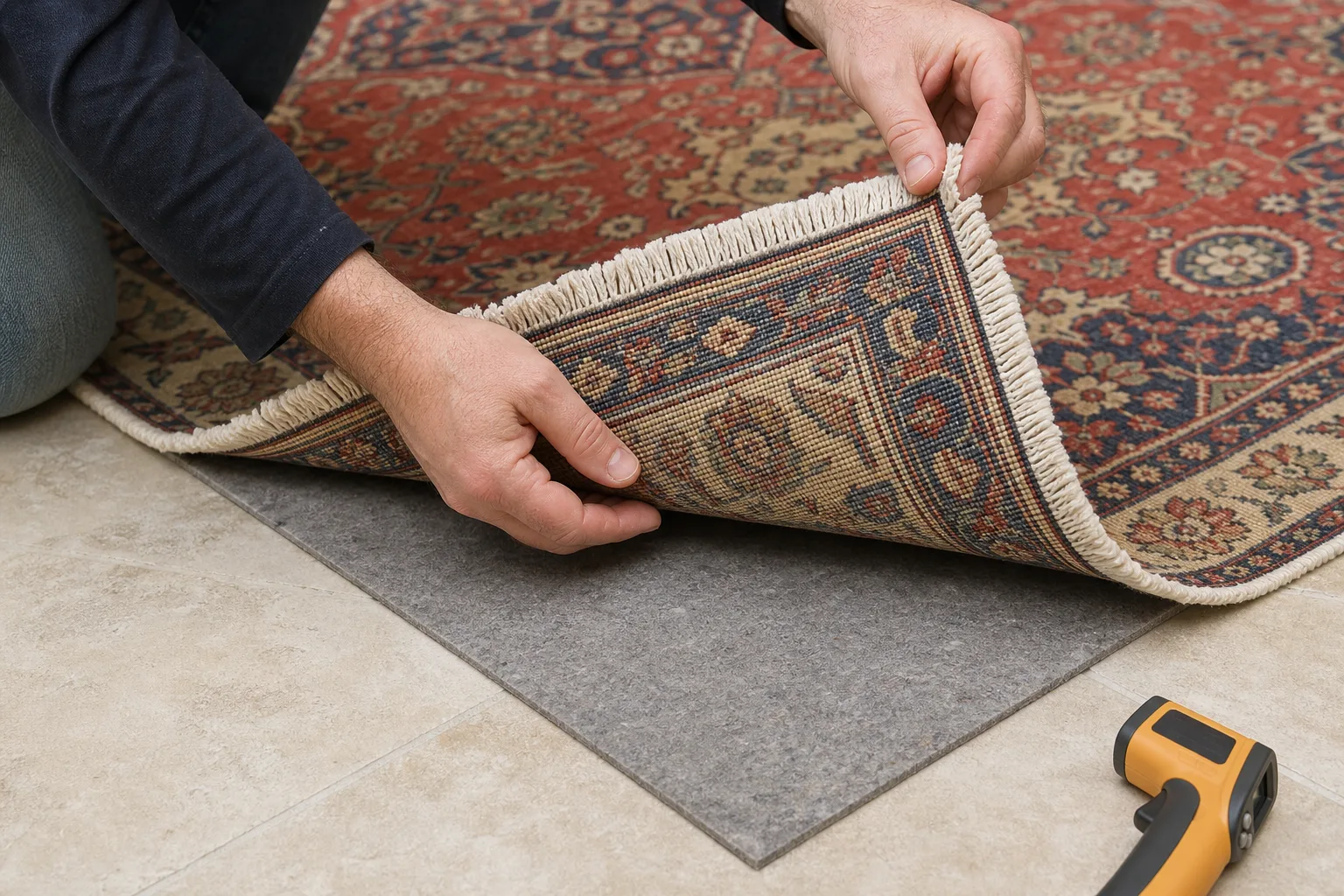
The rug corner, reverse and underlay often show whether warmth can pass through reasonably or will be trapped under the rug.
How to test the rug during the first heating season
Start conservatively. After placing the rug, do not turn the heating immediately to full power. Increase the temperature gradually and lift a corner from time to time during the first few days. The floor should feel pleasantly warm, not hot. If you have an infrared thermometer, compare the open floor with the area beneath the rug.
Watch the rug too. It should not ripple, become stiff, smell unusual, bleed colour or feel overly dry. After wet cleaning, return the rug to a heated floor only when it is fully dry. Moisture trapped between a rug and a warm floor is an unnecessary risk for both the textile and the floor finish.
Wool, silk and older rugs
A good wool hand-knotted rug can tolerate normal indoor warmth well, provided it is not overheated and the room is not extremely dry. Wool is resilient and practical, but prolonged drying does it no favours. During the heating season, a stable indoor climate, regular vacuuming and occasional checks of the reverse and edges help.
Silk, old, fine or restored rugs should be judged more strictly. They may have more sensitive dyes, weakened fringe or older repairs that react less well to heat and humidity changes than a newer wool rug. With this kind of piece, take fewer risks: smaller coverage, lower temperature, no non-breathable underlay and regular inspection.
What to avoid
- large thick rugs covering most of the heated floor area,
- shaggy, fur-like or very high-pile rugs on sensitive flooring,
- rubber and non-breathable anti-slip pads,
- raising the heat simply because you feel less warmth through the rug,
- heavy furniture pressing the rug down and creating another insulated zone,
- placing a damp rug on active heating,
- ignoring the floor or heating system manufacturer’s instructions.
A practical rule for a normal home
If you have modern low-temperature underfloor heating, a suitable floor finish, a reasonably low wool rug and the right underlay, the combination can work very well. Just expect the rug to reduce immediate heat transfer and make the room respond more slowly. That is not a defect; it is a property of the full floor build-up.
If you are not sure, bring photos of the floor, information about the heating system and details of the rug’s front and reverse to the Carpeteria showroom in Prague 5. We can help you assess thickness, material, fringe, underlay and the suitability of a specific hand-knotted rug for a room with underfloor heating.