
Advice and inspiration
Can I use a hand-knotted rug in a high-traffic room?

Yes, a hand-knotted rug can be used in a high-traffic room when its construction suits the load and it is in good condition. A durable wool rug with low to medium pile, a sound foundation and stable sides and ends is usually the best candidate. A fine silk, fragile historic or heavily restored piece belongs in a quieter setting.
The term hand-knotted is not itself a guarantee of durability. Yarn quality, knot security, warp and weft construction, pile height, present condition, correct size and the particular kind of traffic all matter. A living-room rug faces different stresses from a runner beside the front door or a rug beneath a dining table.
What high traffic actually means
It is not only the number of footsteps. Damage also depends on what those feet bring onto the rug and whether everyone follows the same narrow route. Hard grains of sand and dust can reach the base of the pile and act as an abrasive under pressure. Moisture at an entrance, chairs repeatedly sliding or office castors create different risks from ordinary walking in socks.
- Entrance hall: sand, water, salt, wet footwear and abrupt changes in load.
- Corridor: many footsteps within a narrow lane and greater stress on runner edges.
- Living room: traffic is distributed, but sofa and chair feet add local pressure.
- Dining room: moving chairs, crumbs and the risk of spills.
- Home office: castors or chair feet repeatedly load a small area.
- Home with pets: claws, hair, carried dirt and the need to deal with accidents quickly.
Choose the right material first
Good carpet wool is often an excellent choice for ordinary traffic. Its natural resilience helps the pile recover some of its shape after compression. Not all wool is identical, however. Very soft, loosely twisted or short-fibred yarn may pill and shed more quickly, while cohesive resilient yarn holds the surface better.
Silk provides fine drawing and lustre, but in many rugs it is not the first choice for an entrance, dining chairs or a main route. A wool-and-silk mixture needs to be assessed according to where the finer fibre appears. Cotton foundations are common and can be stable, but their condition should be checked carefully in an older rug or one that has been washed inappropriately.
Construction for daily use
For a busy space, look for even balanced knotting, securely seated pile and low to medium height that is neither loose nor excessively soft. The sides should be sound, the ends secure and the rug should lie without serious rippling. An extremely high knot count is not required; a robust rug of good wool can be more practical than a fine piece made from thin material.
Inspect the complete reverse. Old patches, extensive reknotting, hardened adhesive, a failing foundation or large exposed areas may mean that ordinary use will accelerate damage. A well-executed repair need not rule out use, but its extent and structural strength must suit the location.
Matching the rug to the area
| Area | Suitable choice | Main risk |
|---|---|---|
| Interior corridor | Firm wool runner, shorter pile and stable edges | Wear along one route and catching the sides |
| Entrance beyond a mat | Durable wool, darker or multicoloured drawing, cleanable zone before the rug | Sand and residual moisture from footwear |
| Living room | A sufficiently large wool rug connecting the furniture | Uneven traffic and pressure from heavy feet |
| Dining room | Firm lower pile with generous clearance around the table | Chairs, food and liquids |
| Home office | Stable low pile outside the direct castor route | Repeated pressure and surface snagging |
| Quiet setting | A fine, silk, rare or sensitively restored piece | Light and local furniture pressure |
A multicoloured design may conceal fine dust and ordinary changes of pile more effectively than a plain pale field. It must not conceal neglected maintenance. Dirt that cannot be seen can still work abrasively inside the structure.
Stop dirt before it reaches an entrance rug
A hand-knotted rug should not serve as the first mat for wet shoes. Place an effective exterior and interior dirt-control zone before it, provide somewhere for footwear and wet clothing, and clean the mats themselves regularly. The decorative runner can begin beyond that barrier.
If rain or winter weather brings water, salt or grit onto the floor, consider whether the position is suitable for a valuable rug at all. Persistent moisture can affect fibres and colours, while dirt trapped beneath the rug damages both its reverse and the floor.
The correct size reduces edge stress
A runner that is too narrow or short may direct people close to its sides and increase the trip risk. In a living room, an undersized rug creates an edge crossing on every step between sofa and table. In the dining area, every chair leg should remain on the rug when pulled out.
Check door clearance, changes in floor level and surface flatness. Deal with ripples or raised corners professionally; do not attach a sensitive rug to the floor with universal double-sided tape. Adhesive may migrate into the fibres or damage the surface beneath.
An underlay protects both rug and user
An appropriate underlay limits movement, cushions local pressure and separates the reverse from small floor irregularities. It must suit the floor and rug construction, lie flat without overlaps and finish just inside the perimeter so that it does not create a visible step. For a sensitive floor, confirm compatibility with its manufacturer.
Avoid self-adhesive products and materials that soften, crumble or leave a rubbery transfer. Lift and inspect the underlay periodically together with the reverse and floor. Even a good product should be replaced if it degrades or holds dirt.
Vacuum according to actual soil levels
A busy route needs inspection and vacuuming more often than the area beneath a sofa. One fixed calendar cannot suit every home: consider visible dust, children, animals, season and proximity to the entrance. The aim is to remove loose particles before they settle at the base of the pile.
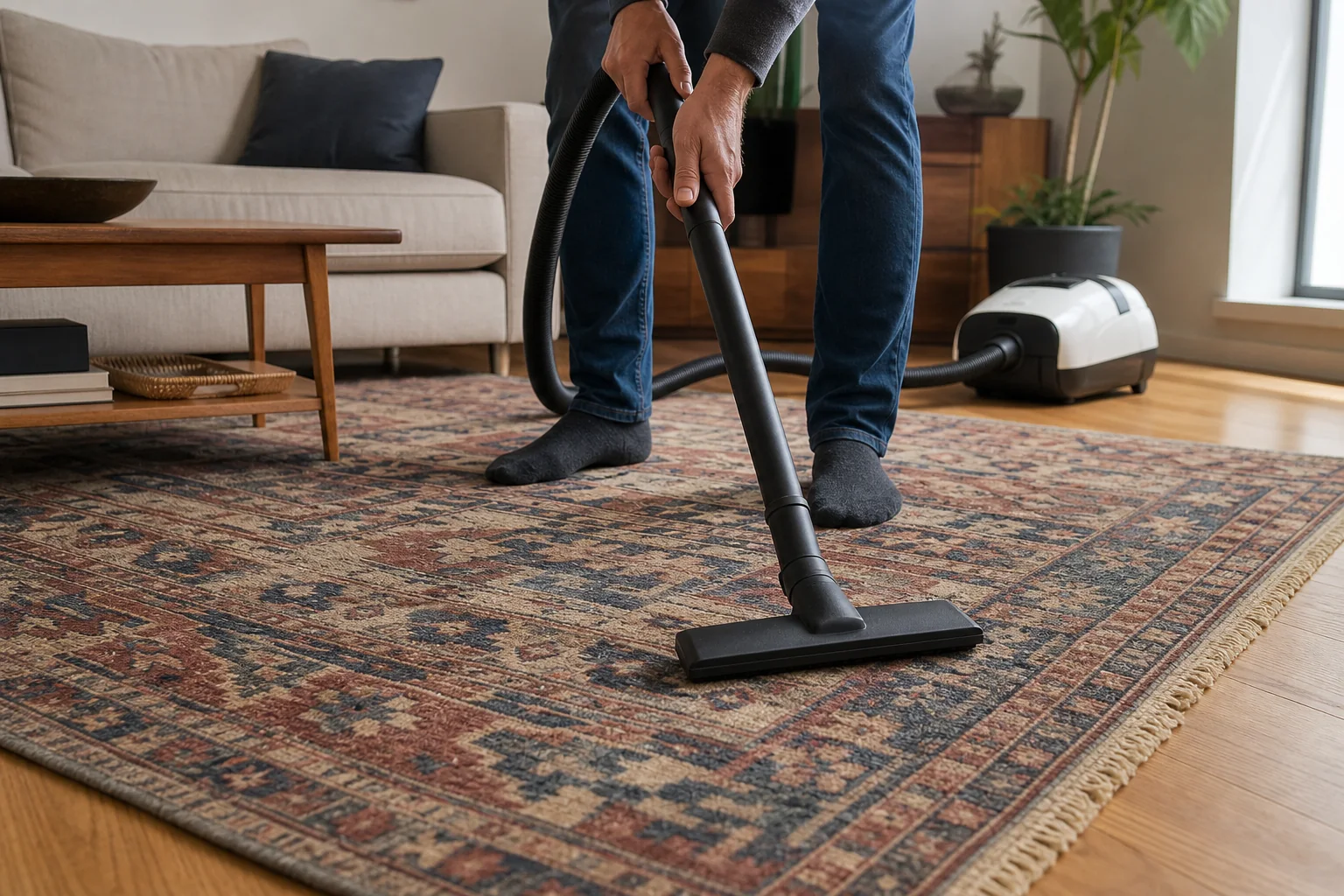
Use adjustable lower suction and a smooth head without an aggressive revolving brush. Work slowly in the direction of the pile and keep the fringe out of the nozzle.
Test the setting first in an inconspicuous area. If the head pulls fibres, catches a repair or loose yarn appears, stop and have the structure assessed. Periodically check the reverse, underlay and floor as well; lift a heavy rug safely with another person.
Blot a spill; do not rub
Absorb liquid as quickly as possible with clean white material, without rubbing or spreading it over a larger area. Remove only loose solids and place dry absorbent material beneath the rug so moisture is not trapped against the floor. Do not use hot water, steam or a universal household mixture without knowing the fibres and dyes.
For a colourful, silk, older or valuable rug, contact a specialist before the stain dries or before attempting to bleach it chemically. A product safe for ordinary synthetic carpet may cause dye migration or change the handle of wool.
Rotation distributes traffic and light
If the shape of the room and pile direction permit, rotate the rug through 180 degrees periodically. Traffic will not remain concentrated at one end and light will not affect only one side. Set the interval by observed use rather than a compulsory number of months for every rug.
When changing the position, lift and carry furniture rather than dragging it over the pile. Use suitable cups beneath heavy feet to distribute the load and alter their positions slightly from time to time. Check that dining-chair feet are smooth and free from sharp edges.
Sun can leave a mark as clearly as footsteps
Prolonged direct light causes fading and can weaken textile fibres. In a glazed corridor or living room, control the strongest sun with curtains, blinds or appropriate shading and compare exposed areas with those beneath furniture.
Rotation helps distribute change but does not stop light damage. If the rug is rare or its colours have low lightfastness, a less exposed and less busy position is preferable.
When not to use a rug in a busy room
- The foundation is brittle, cracking or extensively exposed by pile loss.
- Sides or ends are unravelling and each footstep enlarges the damage.
- The rug has extensive rigid, glued or structurally weak repairs.
- It is a fine silk, rare historic or collecting-grade piece.
- Colours bleed or previous moisture damage remains unresolved.
- The area cannot be kept dry and free from sand, salt or sharp dirt.
- The rug ripples, slips or cannot have its edges stabilised safely.
Such a piece may serve in a quiet room, away from the main route or, after professional assessment, on a wall with a properly distributed support system. Relocation is not a failure; it preserves a textile that no longer has the structural reserve for daily walking.
A short periodic inspection
- View the rug from both pile directions and look for differences in wear.
- Check the sides, ends, fringes and corners for release or lifting.
- Compare the busiest route with an area protected beneath furniture.
- Safely lift part of the rug and inspect the underlay, reverse and floor.
- Look for new stains, damp odour, pest evidence or loose yarn.
- If condition worsens, change placement or care and consult a specialist early.
A well-chosen hand-knotted wool rug need not be an untouchable exhibit. It can age naturally with a home and serve for a long time when its construction suits the load and routine care removes dirt without damaging fibres.
At the Carpeteria showroom in Prague 5, we can assess the particular location, traffic and rug condition. We will recommend an appropriate construction, size and underlay and demonstrate safe care for the pile, edges and fringes.