
Advice and inspiration
Are the colours on hand-knotted carpets stable?

The colours on a quality hand-knotted rug can be very stable, but it is not accurate to promise that they will never change. A rug is a textile: it reacts to light, UV radiation, moisture, heat, dust, cleaning and everyday use. Well-dyed wool can remain beautiful for decades if it is not kept in direct sun and is not cleaned with unsuitable products. Poorly fixed colour, on the other hand, may bleed or fade even on a newer rug.
Colour stability has several meanings. One question is whether colours fade under light. Another is whether they bleed when they meet water. A third is whether they change after unsuitable cleaning or a chemical accident. And a fourth is whether the effect is actually natural abrash, a shade variation caused by different yarn batches rather than damage.
What colour stability really means
Colourfastness is not one single property. A colour may resist ordinary light reasonably well but react badly to an alkaline cleaner. Another may behave well in washing but slowly fade in direct sunlight. Specialists therefore distinguish resistance to light, water, rubbing, washing and chemical influences.
For a rug in an interior, the most important risks are usually light and UV radiation, moisture, cleaning residues and mechanical wear. The better the fibre, dyeing and final washing, the lower the risk of unexpected problems. Even a well-made rug still needs sensible placement and care.
Natural and synthetic dyes are not a simple ranking
A common mistake is to assume that natural dyes are always better and synthetic dyes are always worse. In reality, both can be excellent and both can be problematic. Well-prepared natural dyes can have beautiful depth, subtle tonal variation and traditional character. Modern synthetic dyes can be precise, repeatable and highly stable.
What matters is the particular dye, fibre, mordant or fixation process, water, temperature, pH, final rinsing and quality control. With older rugs, history also matters: sunlight near a window, storage conditions, moisture, previous cleaning and repairs.
Light is the main long-term enemy of colour
Visible light and UV radiation can cause fading and colour change. The damage happens gradually, accumulates and cannot simply be reversed. Direct sunlight near a window is far riskier for textiles than diffused daylight. UV film on glass can help, but it does not remove the whole issue because visible light also contributes to fading.
If a rug lies in a room with a large south- or west-facing window, watch whether one part is illuminated for long periods. Curtains, blinds, UV film, changing furniture positions and rotating the rug 180 degrees all help. Very valuable, old or silk rugs are best kept out of direct sun altogether.
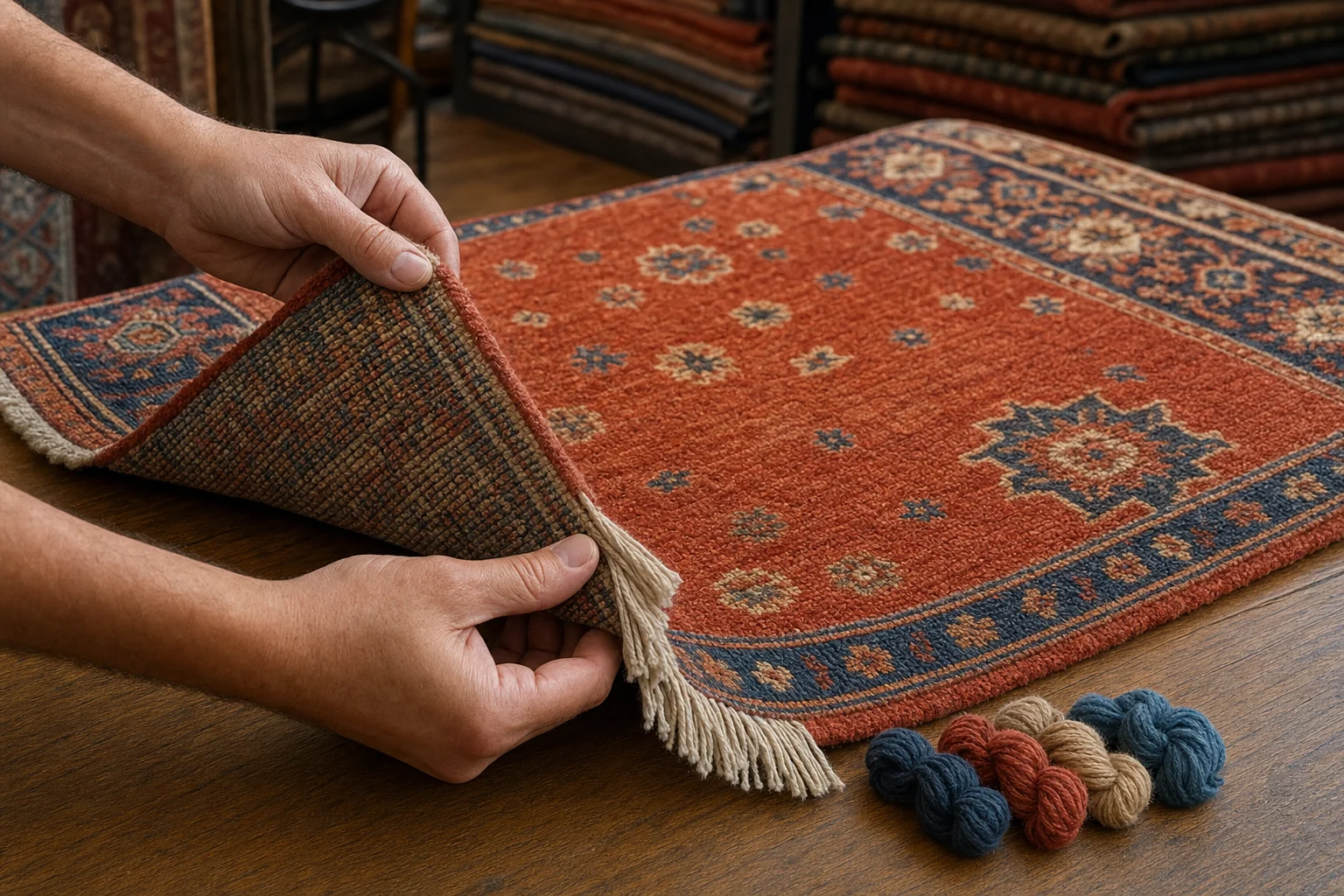
The reverse, edges and yarn samples help distinguish natural colour nuance from real fading or dye bleeding.
Abrash is not the same as fading
Abrash is a shade change that develops during weaving when yarn from a different batch or dye lot is used. It often appears in horizontal bands or soft transitions across the field. In hand-knotted rugs it may be a natural and appreciated part of the rug's character.
Sun fading usually follows the place of exposure: the area near a window, under a direct beam or outside the shadow of furniture becomes lighter. Abrash, by contrast, relates to the progress of weaving and often continues more logically across the pattern. If uncertain, compare the face, reverse and protected areas under a folded edge or beneath furniture.
Bleeding is a different problem from fading
Fading means that colourants break down or change because of light and time. Bleeding means that colour releases and migrates into another part of the rug, for example through water, steam or a cleaning product. On a rug with a red field and pale border, unsuitable cleaning can move red colour into light areas.
That is why we do not recommend a home wet-cloth test on a visible area or general household cleaners. If the rug has value or strong colour contrast, a specialist should assess colour stability before washing. Professional testing is controlled, and even then it is only one part of deciding whether wet cleaning is appropriate.
What affects colour stability in practice
| Factor | What it may cause | How to reduce the risk |
|---|---|---|
| Direct sunlight | Fading, yellowing of fibres and textile weakening | Curtains, UV film, rug rotation or a different position |
| High moisture | Dye migration, mould, odour and weakened foundation | Dry ventilated rooms and quick response to spills |
| Unsuitable cleaning | Bleeding, staining and changed handle | No universal chemicals; specialist washing for valuable rugs |
| Dust and abrasion | Dullness and uneven pile wear | Gentle vacuuming and regular rotation |
| Poor dyeing quality | Fast fading or transfer into pale areas | Buy with clear information on origin, material and condition |
How to check colour when buying
Look at the rug in daylight and artificial light. Turn a corner over and compare the face with the reverse. The reverse often shows the original depth of colour more clearly than worn pile. Check the sides, fringe and areas that may have been protected from light. On an older rug, ask whether there is one-sided fading, water staining or evidence of repair.
If a rug has very strong reds, blues or blacks beside pale areas, ask about recommended cleaning and colour stability. With new custom rugs, ask whether the yarns were properly rinsed after dyeing and whether the maker checks fastness. With an antique piece, condition and history matter more than a promise of “perfect colour”.
How to protect colour at home
- Do not leave the rug in long direct sunlight, especially beside large windows.
- Rotate it 180 degrees periodically so light and traffic are distributed more evenly.
- Blot spills without rubbing and without chemical experiments.
- Avoid steam cleaning and general household products unless suitability is confirmed.
- Vacuum gently so dust does not abrade the pile like grit.
- Keep the rug dry and check that the underlay does not trap moisture.
- For valuable, silk or older rugs, discuss washing with a specialist.
When colour change is normal and when it is a warning sign
A gentle mellowing of tone over years is normal for textiles. A colour shift caused by pile direction or subtle abrash can also be natural. Warning signs include sharp local fading, pink or red staining in pale areas, water marks, chemical odour, stiff areas after cleaning, or an obvious difference between the part near a window and the part under furniture.
Good colour does not mean that a rug can lie anywhere and survive any cleaning method. It means that dye, fibre and workmanship are in balance and that with proper care the rug will change slowly and naturally. At the Carpeteria showroom in Prague 5, we can show you the difference between abrash, pile direction, normal ageing and real colour damage.